





If you're here, you're probably not looking for another thing to put in the room.
You're thinking about how they'll actually be. Not on the day, when there's too much going on for anyone to feel much of anything, but a few weeks in, when it's gone quiet, home feels further away than expected, and you're not down the hall any more.
That's a kind thing to be thinking about, and it's the right instinct. First term asks a lot of someone emotionally, and it asks it at exactly the point they have the least support around them. Something small and kind, arriving at the right moment, can do more than its size suggests.
Quick answer
The best gift for a homesick university student is small, personal, and useful on a difficult night rather than a good day. Something that lives on a desk or in a pocket in a very small room, works in a few seconds, and doesn't need charging, storing, explaining or replying to.
Homesickness tends to arrive in the quiet parts of the day, which is almost never when anyone thinks to reach out. That's why an object already in the room does work a message can't: it's there at eleven at night without anyone having to ask for it.
The three that do that best are affirmation cards written for students, a You Are Loved charm for their keys, and a guided journal for someone who thinks by writing.
And the timing matters more than most people realise. Weeks four to seven are harder than move-in day, because that's when the newness goes and everyone assumes they've settled. Something arriving then does far more than something handed over in September.
Free handwritten note | Posted straight to halls if you'd like
If you're reading this before they've gone: nothing here perishes and nothing needs charging, so you can order it now while you're thinking about it and keep it back until October. Or send it straight to their halls, and I'll write your note by hand so it's waiting for them when it lands.
Full transparency: I'm Rachel Smith, a qualified meditation teacher, and everything on this page is something I make. I've written what each one is for and who it suits, so you can tell quickly whether it's right for the person you have in mind. The part on timing is the bit I'd most like you to take away, and it costs nothing. More about me →
What they're actually walking into
Most of the advice about university is practical. Can they cook, can they use a washing machine, have they got enough towels.
The part that's harder to pack for is this: for a lot of people, first term is the first long stretch of being their own main source of comfort. Not because anyone at home has stopped, but because you won't be in the next room at eleven at night when something has gone wrong and they're deciding whether it's worth telling anyone.
That's the gap you're really trying to help with, and it's worth understanding before you choose anything.

Sophia Spencer
Specialist CBT psychotherapist with many years of experience in the NHS, including senior roles supervising and training other therapists. Specialises in social anxiety, using Compassion Focused Therapy alongside CBT and ACT
"One of the most damaging aspects of social anxiety is the belief that we're somehow uniquely challenged by social situations, whilst everyone else navigates them effortlessly. This couldn't be further from the truth. Research consistently shows that social anxiety is incredibly common."Read Sophia Spencer's full article →
That belief is most of what first term feels like from the inside. A corridor of people who all arrived on the same day, most of them quietly convinced that everybody else has made friends already, understood the reading already, worked out how any of this is supposed to feel.
And Sophia Spencer names what tends to happen next, which is the bit that does the damage: "we criticise ourselves for being nervous, creating a secondary layer of distress atop the original anxiety." It isn't just that it's hard. It's the giving yourself a hard time for finding it hard. That second layer is the one you can actually help with from two hundred miles away.
Home is something they'll be rebuilding on the inside
This is the idea I'd most like to hand you, and it comes from a counsellor rather than from me.

Georgia Jackett, MA, CCC
Canadian Certified Counsellor with a Masters in Counselling Psychology, specialising in anxiety, relationships and trauma work
"What if home could be more than a place or person. What if home was also what you felt within yourself?... Where your internal world feels safe, comfortable, inviting, and warm. Where you feel at peace, and your mind is an encouraging place to be."Read Georgia Jackett on being at home with yourself →
Home, for most of us, has meant somewhere we felt seen, safe and welcome. In September they take that idea to a place with a shared kitchen and a stranger's music through the wall, and they start building it again, this time on the inside.
That is what you're actually giving them a hand with. Not homesickness. Home-building.
Georgia Jackett also makes a distinction that fits student life exactly. Proactive self-care is "tuning into what you need, and meeting those needs before you crash". Reactive self-care is "when the crash already happened". In a first term, it's very easy to only ever discover the second kind. Anything that nudges gently towards the first, in a few seconds a day, is worth more than it costs.
And the timing matters more than the gift
Everything arrives at once in September. The car is full, the flat is full, and for a fortnight there's too much going on for anyone to feel much of anything. Then it goes quiet.
Freshers, introductions, the strangeness of a room that's theirs. Anything given now tends to get absorbed into the general chaos of moving in. Nothing wrong with that, it just doesn't do much yet.
The newness has gone, the first real deadlines have landed, and people at home have often stopped asking because they assume it's all sorted now. This is the stretch where it's common to quietly wonder whether you've made a mistake, and it's when a parcel does the most good.
First proper assessments, then the return after Christmas, which catches people out because second term is expected to feel easier.
If you send one thing, send it in October rather than September.

Annabelle Kyle Dortch, PsyD
Clinical psychologist specialising in helping people navigate life transitions, relationships, stress, anxiety and the impacts of trauma
"When we engage in self-criticism, we create a nervous system and brain state that is not conducive to learning or facilitating a growth-oriented mindset."Read why self-compassion beats self-criticism →
Worth holding on to if there's a part of you wondering whether being kind to themselves might make them coast. It seems to work the other way round. Being hard on yourself gets in the way of the thing they've gone there to do. The kinder voice isn't the soft option. It's the one that leaves enough room to think clearly and work.
What makes a gift actually get used
- Small enough for a very small roomHalls rooms are tiny and storage is worse. Something that lives on a desk or in a pocket tends to get kept. Anything that needs finding a home for becomes a problem they have to solve.
- It helps on a bad night, not just a good dayMost going-away gifts assume things are going well. The ones that matter still make sense at eleven at night in week six, when it isn't clear who to tell.
- It works in four secondsAttention comes in fragments in term time. Anything that needs proper time set aside will wait for a quiet evening that never quite arrives.
- It looks like something they choseIt has to sit happily on a desk when a flatmate wanders in. Something beautiful stays out. Something that looks like a worried parent sent it tends to go in a drawer, and then it can't help anyone.
Three things that help, and what each one actually does
All three are mine, so you're reading the person who makes them. What I can give you is a straight description of what each one is for and who it suits, so you can tell quickly whether it's right for the person you have in mind.

Student Affirmation Cards
The one I'd choose first
It's a Tuesday in late October. The seminar didn't go well, they've said the wrong thing in the group chat, and they're sitting at that little desk feeling like the only person in the building who hasn't settled in. They look up. Propped against the lamp is a card that says "I can do things I cannot do yet."
That's the whole idea. Twenty cards written for exactly this stage, and not one of them mentions grades. They're about being allowed to not know yet, to change your mind, to be on a different timetable from everyone else. The kind sentence is already in the room, so it doesn't have to be thought up on the night it's hardest to think of. It's the difference between hoping they'll be kind to themselves and actually giving them the words.
Added to your basket. View basket →
Worth adding the brass stand so one can live on the desk permanently rather than in a drawer. Full details and photographs →

Collette Jones, LCSW
Licensed therapist and practice owner. Reviewing the affirmation cards
"These cards are a beautiful tool that offer gentle reminders to soothe the mind, ease tension, and cultivate a sense of peace. Unlike other affirmations that can veer into forced positivity, these cards focus more on affirming self-acceptance and self-compassion."

The You Are Loved Charm
For someone who'd rather not make a fuss, and for missing home
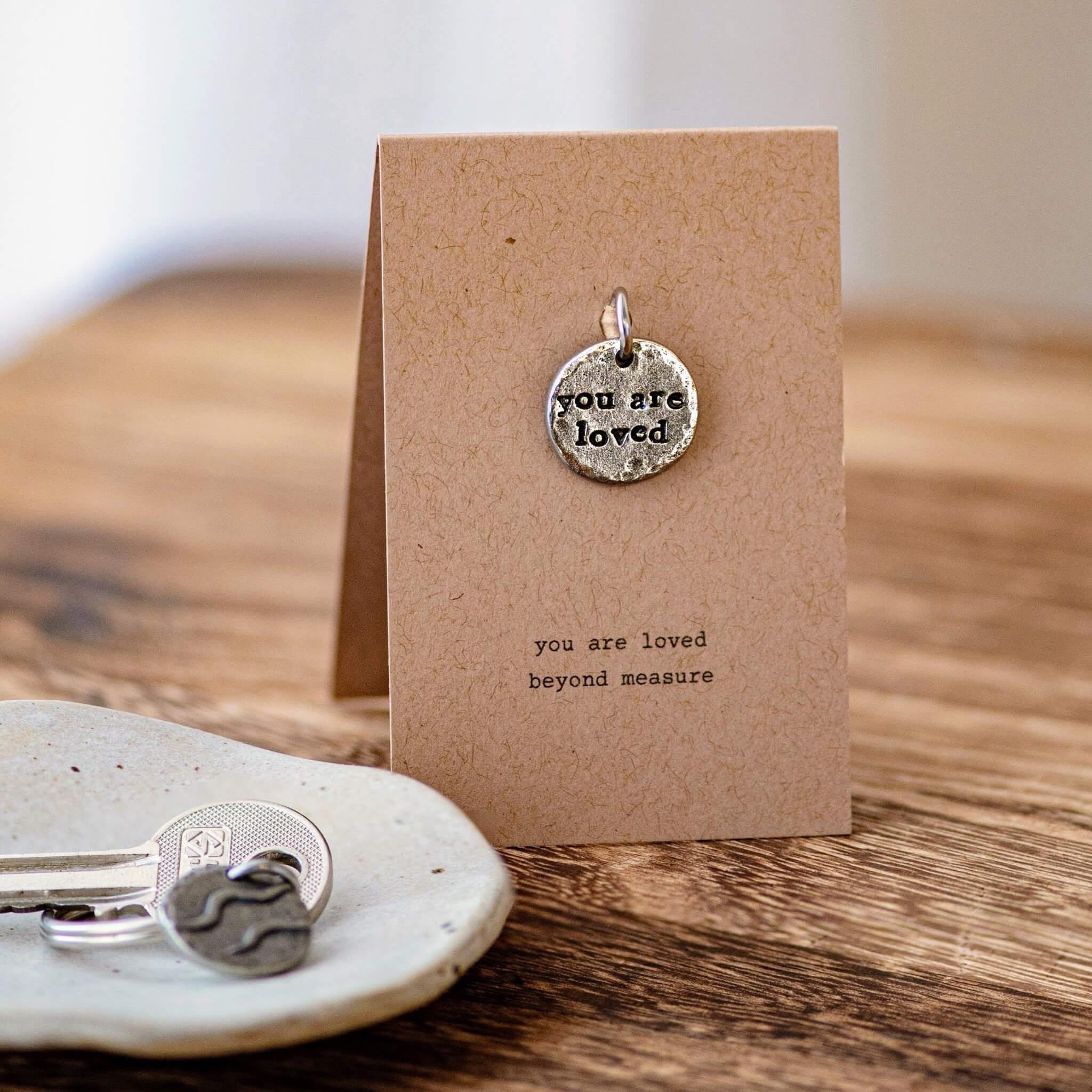
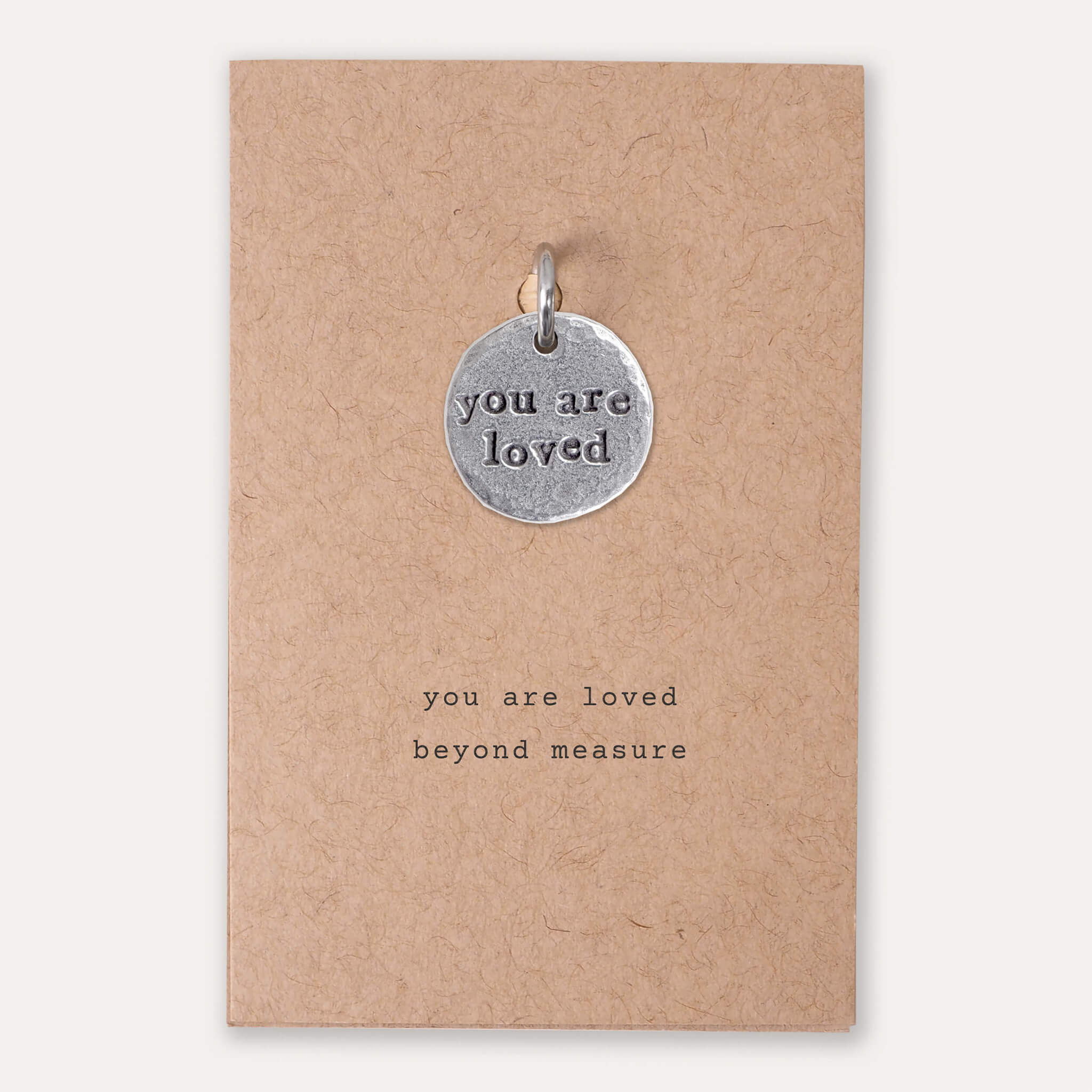
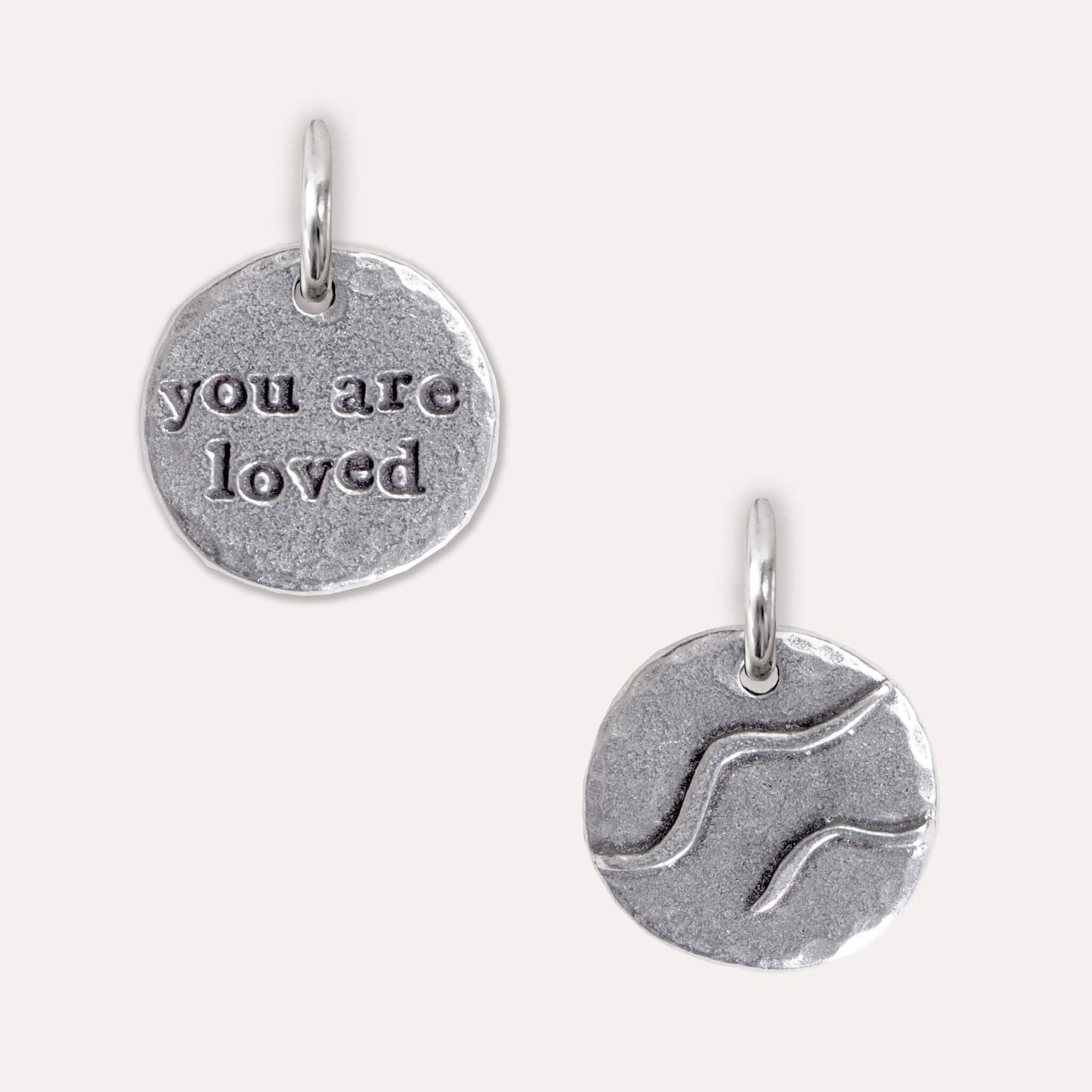
They let themselves into a building that isn't home yet, several times a day, and every time their thumb finds three small words on the keyring. Nobody else notices. There's nothing to talk about. It's just there.
Homesickness isn't really about the house. It's about being somewhere nobody knows you yet, and this is the one that answers that directly. You are loved is also the thing you're actually saying by sending it, so it carries your voice rather than asking them to generate the feeling themselves. At £8.95 nobody feels indebted, it can't be lost in a small room because it's attached to the one thing they can't leave without, and it says something out loud that families often assume is understood.
Added to your basket. View basket →
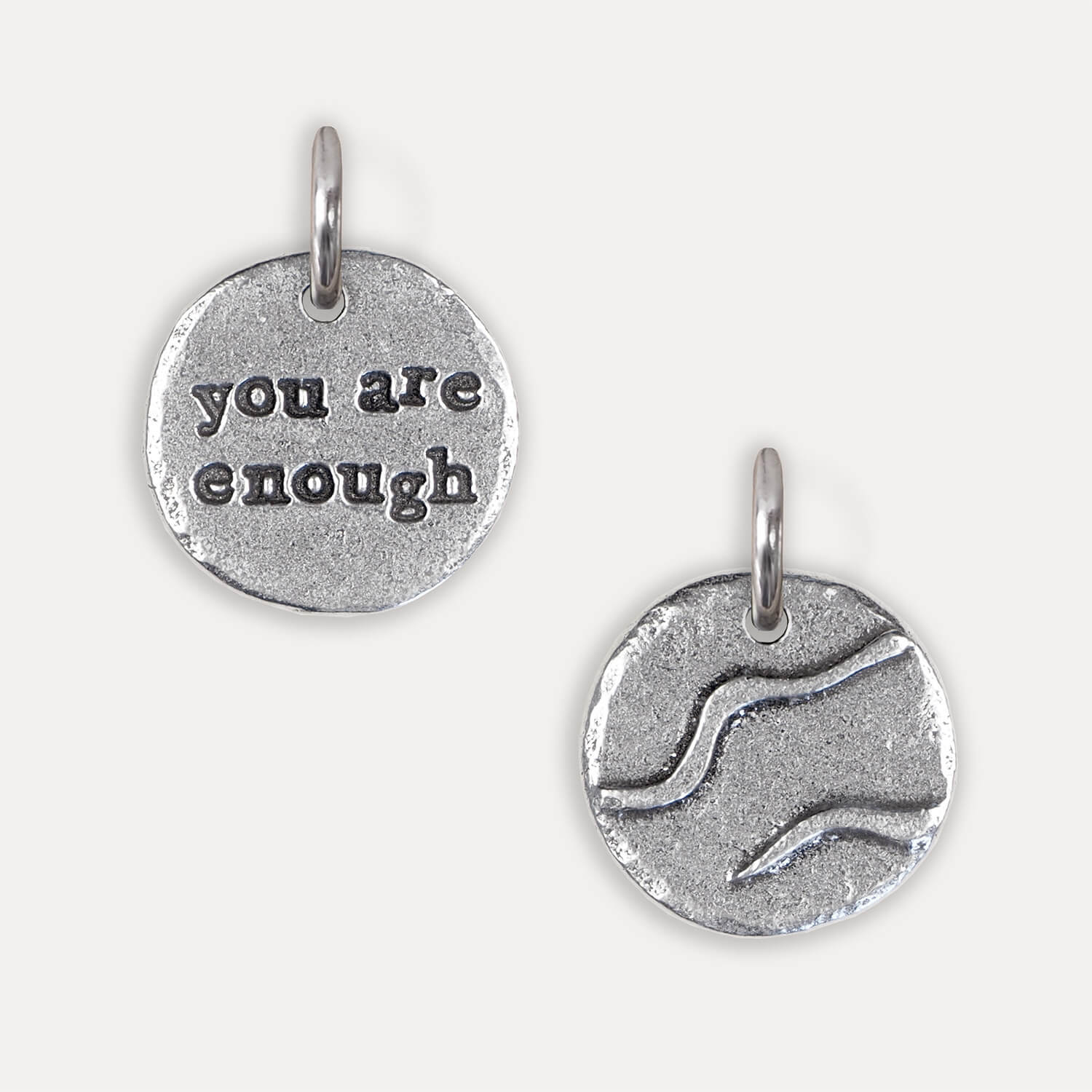
If it's more "I'm not good enough" than "I miss home", the You Are Enough charm is the same little object with the other sentence on it, and it's the one I'd send for that. Worth knowing: on its own as a main send-off gift a charm can feel a little slight. It's lovely tucked in with the cards, or posted by itself in October. Full details →

The Give Yourself Kindness Journal
For someone who thinks by writing, or is going a long way from home
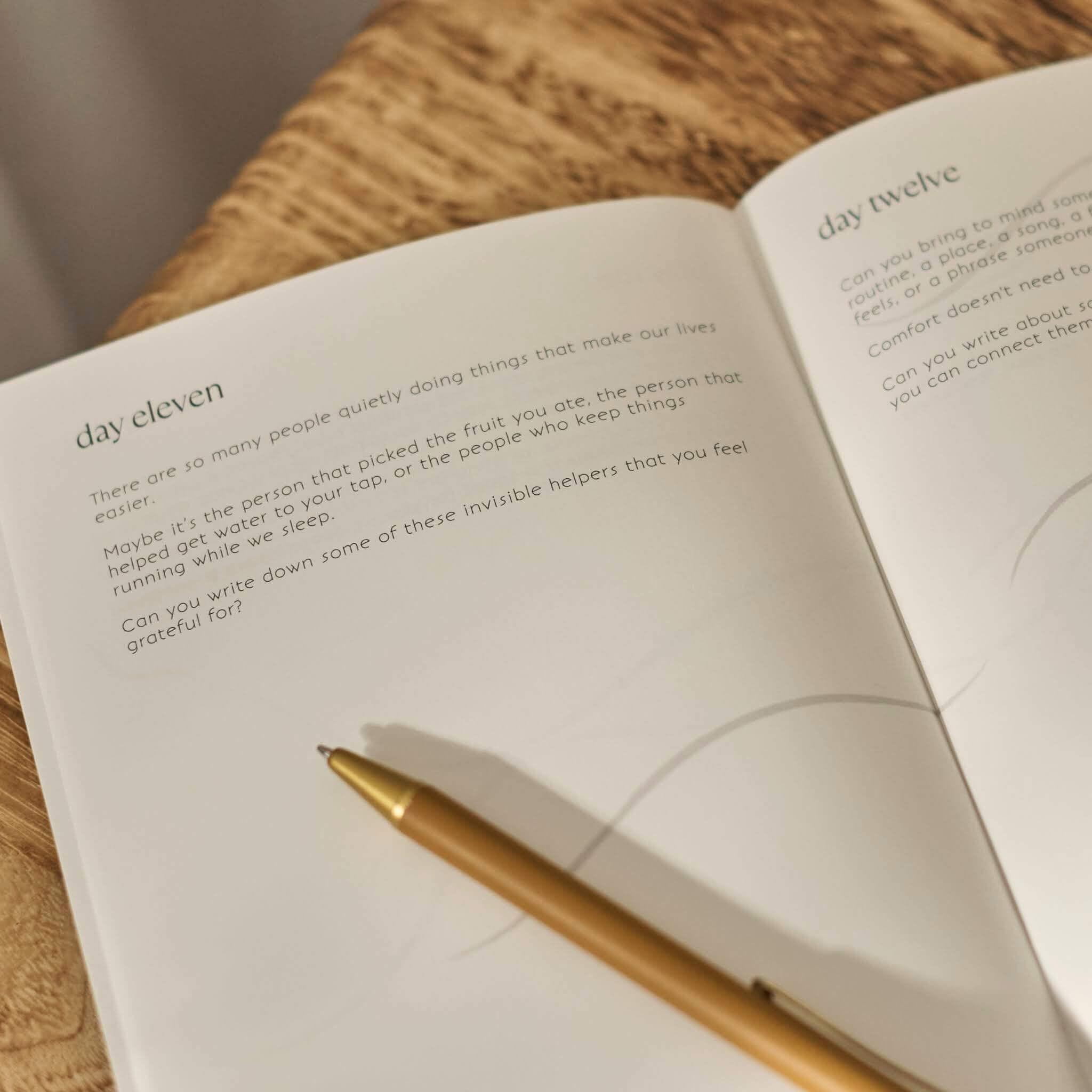
Sunday evening. Everyone's gone quiet, the week ahead is looming, and something from Friday is still sitting on their chest. They open it, and the page asks: what has challenged you today? Talk to yourself as you would talk to a friend. A little while later the thing has a name, and it's easier to hold.
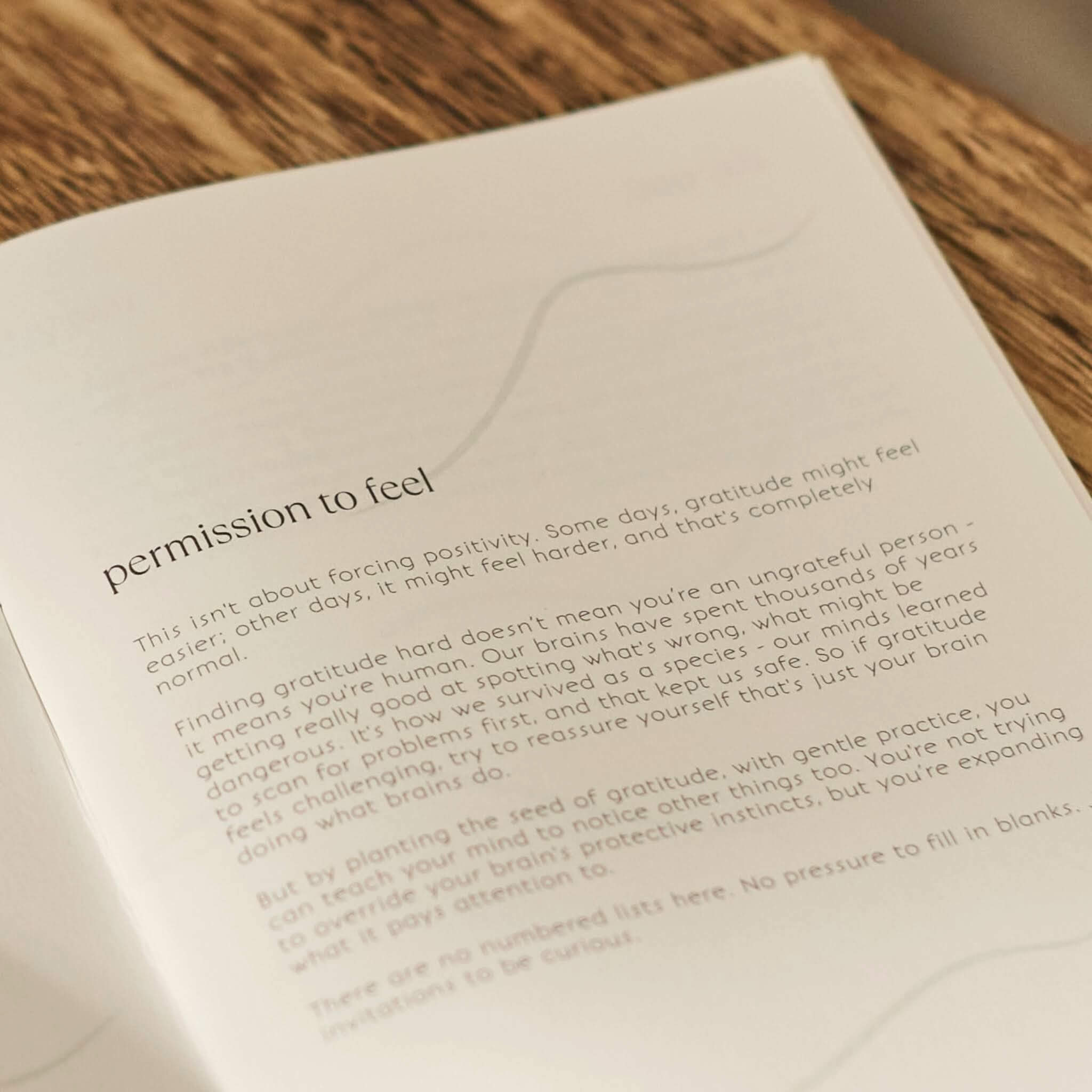
This is the deeper tool, for someone who processes by writing or who feels things a bit more than most. Every prompt is different, so it never goes mechanical, and there's a visual emotional awareness tool on every page for the evenings when "fine" is genuinely all they can find. It's undated, so a fortnight of not touching it leaves no trace and no guilt, which matters when term gets busy.
Added to your basket. View basket →
Reviewed by clinical psychologists at Harvard Medical School and the University of Oxford, and used by therapists with their own clients. Worth knowing: if they've told you writing isn't their thing, believe them and send the cards. Full details →
If this is the main present, the cards and the journal go together
These two aren't a duplicate, they're a pair. The cards are for the four seconds they have on a difficult Tuesday. The journal is for the Sunday when there's a bit more in them. Between them you've covered both the moment something goes wrong and the moment there's space to make sense of it, which is about as much as any object can do from a distance.
Add both to the basket above and they'll arrive together, wrapped in the same tissue paper. See everything suited to a university student →

Margaret Davis, MS, LPC
Licensed therapist. Reviewing the Give Yourself Kindness affirmation cards
"These affirmations are truly so beautiful and powerful! When I read them, I instantly feel a sense of groundedness and calm. I also love that they are centered around having more compassion and kindness for ourselves. I will definitely be utilizing these with my clients, as well as practicing them myself."See all the expert reviews →
Georgia Jackett describes what self-compassion actually sounds like in practice, and it's close to what's printed on these cards: "It makes sense that I feel anxious, and I also know I can do this." That's the sentence you're posting them. Not cheerleading, not pressure. Permission to find it hard, and a quiet reminder that they're capable anyway.
Everything arrives wrapped in bespoke tissue paper, and you can add a handwritten note free by typing it into the order notes at checkout. Send it straight to their halls if you'd rather it turned up as a surprise in October than went in the car in September. Nothing here perishes, so ordering now and keeping it back until then works perfectly well too.
What to write in the note
You know them far better than I do, so take anything here that's useful and leave the rest.
Most people find the note harder than choosing the gift, which makes sense. It's the part carrying the actual message, and there's a lot riding on a small card. Below is what I've noticed tends to land well, a couple of things that can land differently from how they were meant, and some lines you're welcome to use word for word.
Tends to land well
- Saying now the thing you'd say if they rang you upset, so it's already there when they need it.
- Taking the pressure off replying.
- Naming that it's allowed to be hard, without trying to fix it.
- Something specific and ordinary from home. The dog, the kettle, a running joke.
Can land differently from how it's meant
- A question. "Let me know how you're getting on!" is warm, and it's also a small task, and they already have a list of those.
- A promise that it'll fly by. In week five that can read as being told their experience is wrong.
- Anything that needs a proper reply. A note that asks nothing of them is easier to keep.
If you're giving it before they go
"No reply needed. I just wanted something of ours on your desk."
"Open this one when you've unpacked and everyone's gone home."
If they seem homesick
"It's allowed to be harder than you expected. That isn't a sign you chose wrong."
"Missing home means you had somewhere good to miss. Ring me for no reason whenever you like."
If they've gone quiet
"Nothing needed back. Just thinking of you today."
"I'm not checking up. I'd just rather you had this than didn't."
If it's deadlines or exams
"However this one goes, it doesn't change anything about you."
"You don't have to earn a rest. Have one anyway."
If it didn't go how they hoped
"You don't have to be enjoying it yet."
"Everyone in that building is pretending they've got it sorted. Nobody has."
If you're not their parent
"Your mum said you'd settled in brilliantly. I thought you might want something for the days that aren't so brilliant."
"You've been on my mind. That's the whole message."
If you genuinely don't know what to say
"I couldn't think of the right words, so I've sent something that has some in it. Love you."
"Thinking of you. Always here."
Add yours in the order notes at checkout and I'll write it out by hand and put it in with the gift.
Common questions
What can I send someone who's homesick at university?
Something that stays in the room and keeps saying the thing you'd say. Homesickness tends to arrive in the quiet parts of the day, which is rarely when anyone thinks to reach out, so an object that's already on the desk does work a message can't. A handwritten note naming something ordinary from home, alongside something small they can keep out, tends to land better than anything expensive.
What's a good gift for a university student who's struggling?
Something small that works on a difficult night rather than a good day, and that asks nothing of them. A card with a kind sentence already written on it, a charm on their keys, or a guided journal all fit that shape, because each one works in a few seconds and doesn't need a reply. What matters more than the object is that it arrives without any expectation attached, so it reads as support rather than as being checked up on.
What's a good gift for someone going to university with anxiety?
Something quiet, in their own hands, that doesn't ask them to talk about it. Specialist CBT psychotherapist Sophia Spencer describes the belief that everyone else is coping effortlessly as one of the most damaging aspects of social anxiety, and notes that research consistently shows social anxiety is incredibly common. Anything that gently contradicts that belief, in private, at the moment it's loudest, is doing the useful work. Nothing that needs charging, storing or explaining to a flatmate.
What's a good gift for someone going to university?
Something small, personal, and useful on a difficult night rather than a good day. Rooms are tiny and storage fills up fast, so anything bulky becomes a problem they have to solve. The gifts that get kept sit on a desk or in a pocket, cost little enough that nobody feels indebted, work in a few seconds, and look like something they chose. Affirmation cards, a charm on their keys or a guided journal all fit that shape.
When should I send it?
October rather than September, if you're only sending one thing. The first three weeks are carried by novelty and anything given then tends to get absorbed into moving in. Weeks four to seven are when the newness wears off, the first deadlines land, and people at home stop asking because they assume it's settled. That's the window where a parcel does the most good.
Can I order now and send it later?
Yes, and plenty of people do. Nothing here perishes and nothing needs charging, so you can order while you're thinking about it and keep it back until October. If you'd rather it went straight to their halls, put their address in at checkout and add your note in the order notes, and it arrives wrapped and ready without going in the car in September.
Why does self-compassion matter so much at university?
Because first term is shaped by a very specific belief: that everyone else has worked it out and you're the only one struggling. Specialist CBT psychotherapist Sophia Spencer describes this as one of the most damaging aspects of social anxiety. What makes it worse is the second layer, where people criticise themselves for being nervous, creating a secondary layer of distress atop the original anxiety. Self-compassion works directly on that second layer, and clinical psychologist Annabelle Kyle Dortch points out that self-criticism creates a brain state not conducive to learning, so it affects the work itself as well.
Do affirmation cards genuinely help, or is it a nice thought?
They help by making the kind sentence available at the moment it's needed, which is almost never the moment anyone would go looking for it. Counsellor Georgia Jackett describes what self-compassion sounds like in practice as something close to: it makes sense that I feel anxious, and I also know I can do this. Having that on a desk means it's already in the room. What they won't do is write the essay or make the friends, and anyone promising that is overselling.
They've said they don't want anything sentimental. What then?
Go small and go quiet. The You Are Loved charm at £8.95 on their keys, or the cards with a one-line note. Plenty of people would rather not have a moment made of it, and that's completely fine. Something beautiful that sits on a desk without announcing itself works far better for them than anything that needs a conversation.
Can you post it straight to their halls?
Yes. Put their address in at checkout, add a handwritten note free in the order notes, and it all arrives wrapped in bespoke tissue paper. Most halls have a parcel room, so it's worth a quick check of how theirs handles post.
What if I'm genuinely worried about them?
Then a gift isn't the tool, and I'd rather say so. Every UK university has a wellbeing or counselling service and most have a GP practice attached, both free and both used far more than students realise. Helping them make one appointment is worth more than anything on this page. These can sit alongside that, not instead of it.
You can't go with them, and you can't ring every day without becoming the thing they start avoiding.
What you can do is leave something kind in the room, so that on the nights you aren't there to say it, something else is.