



Quick answer
The most reliable way to identify an emotion is to choose from words already in front of you, rather than trying to summon one from nothing. It works like this:
- Read a list of emotion words and notice which ones your body reacts to. There's a free one on this page.
- Take two to four, not one. Feelings rarely arrive alone, and conflicting ones can sit side by side.
- Check the body if the words won't come. A tight chest, a lump in the throat, heat in the face: physical signs often arrive before language does.
- Get specific. "Disappointed" helps more than "bad." The more precise the word, the more the feeling tends to settle.
Why it works: naming a specific emotion tends to reduce its intensity. Neuroscience calls this "affect labelling." Dr Kristin Neff puts it as "name it and you tame it."
And if nothing fits: that's ordinary, and it isn't a failure. Not knowing what you're feeling is genuinely common. You can still be kind to yourself without ever landing on the word, and psychotherapist Nina Holle's 4 A's below show you how.

If you'd like a little help finding the words: every page offers you a fresh spread of emotion words to choose from, alongside a new prompt to explore why. So you're never sitting in front of a blank page, wondering where to start.

"A warm invitation to make friends with your emotions and yourself!"Dr. Chris Germer, PhD Clinical Psychologist, Harvard Medical School
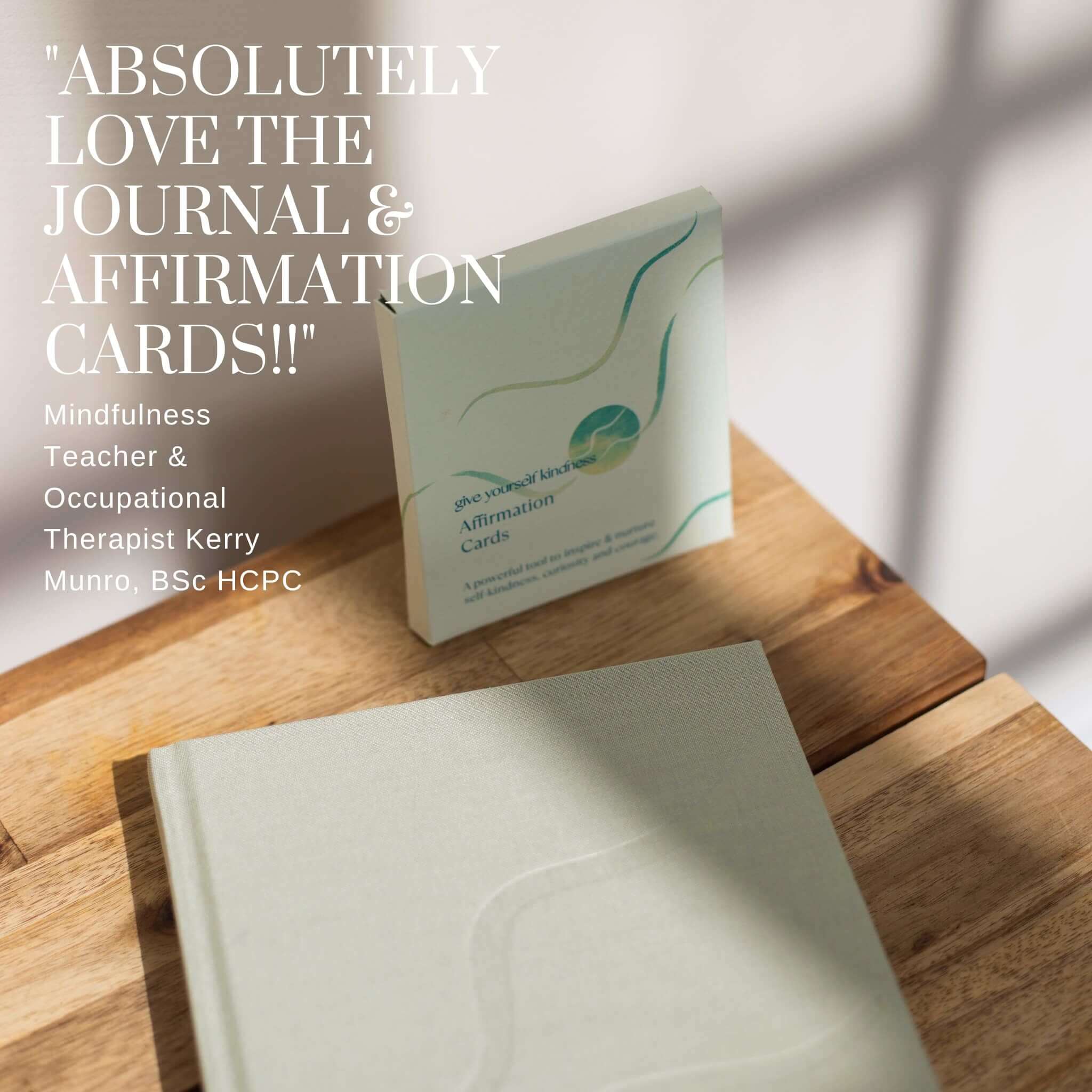
Full transparency: I'm Rachel, and this is my journal. After struggling to identify my own emotions, I made the tool I wished had existed, and it's now recommended by clinical psychologists from Harvard and Oxford. What I want is to create things that genuinely help, and to share everything I've learnt in the years I've spent exploring this. The word list, the exercises and the expert articles on this page are free and always will be.
If you can't name what you're feeling, it's not your fault
Not knowing what you're feeling is far more common than it sounds. It's a genuine skill, it's harder than most people expect, and it isn't something anyone picks up in an afternoon.
There are good reasons it's difficult:
- Most of us were never taught. School covers maths, science and history. Very few of us were ever shown the difference between disappointed and discouraged, or anxious and overwhelmed.
- The vocabulary may not be there yet. It's hard to name something you don't have a word for. That isn't a failing, it's a gap in what we're taught.
- Tuning out can be a form of protection. For some people, emotions weren't safe to express growing up, and the mind learned to turn the volume down. That was protective then, and it can make naming things harder now.
- Noticing takes space. Slowing down enough to check in is hard in a full day, and most days are full.
So if this feels difficult, the difficulty is real and it's valid. Be gentle with yourself here. Nothing on this page needs to be done perfectly, or in order.
I'm not a therapist. But after my own struggle with anxiety, learning to name what I was actually feeling through Compassion-Focused Therapy changed a great deal for me. This guide brings together what I've learnt alongside the work of licensed therapists and psychologists who specialise in emotions, with practical exercises you can try.
Why naming an emotion helps
This isn't self-awareness for its own sake. There's real science behind why putting a word to a feeling is useful. When you identify and name a specific emotion:
- Amygdala activity tends to decrease. That's the brain's alarm system. Naming an emotion seems to tell the brain "I see this, I recognise it," which can reduce the threat response.
- Prefrontal cortex activity tends to increase. That's the reasoning centre, and more activity there tends to mean clearer thinking.
- The intensity often softens. The feeling doesn't disappear, but it can become more manageable.
This is called affect labelling, and it's one of the more reliable emotion regulation techniques we have (Lieberman et al., 2007). Dr Kristin Neff, who developed the self-compassion scale at the University of Texas at Austin, puts it more simply in her piece for this site: "Naming or labeling difficult emotions helps us to disentangle, or 'unstick,' from them... Name it and you tame it."
Day to day, that can mean responding rather than reacting, saying what you need more clearly, noticing patterns, and being on kinder terms with yourself. It takes time to build, so please be patient. Every attempt at naming something, including the ones you're not sure you got right, is practice.
A list of emotion words to choose from
You can't name a feeling you don't have a word for, so here's the vocabulary, free and in one place. Read down the columns and see which words your body reacts to. There's nothing to sign up for and no wrong answer.
-
Sad
down · low · heavy · disappointed · discouraged · lonely · homesick · wistful · grieving · despairing · empty · tearful
-
Angry
irritated · annoyed · frustrated · impatient · resentful · indignant · bitter · outraged · furious · defensive · provoked · fed up
-
Anxious or afraid
uneasy · on edge · nervous · worried · apprehensive · dreading · panicky · jumpy · unsafe · braced · scared · terrified
-
Hurt
let down · rejected · excluded · unseen · dismissed · betrayed · abandoned · humiliated · wounded · taken for granted · disrespected · tender
-
Ashamed or guilty
embarrassed · self-conscious · exposed · foolish · regretful · remorseful · inadequate · not enough · small · wanting to hide · unworthy · sorry
-
Overwhelmed
stretched · swamped · frazzled · scattered · pressured · rushed · stuck · helpless · torn · wired · keyed up · can't think straight
-
Flat or tired
drained · weary · depleted · numb · blank · detached · foggy · unmotivated · bored · indifferent · switched off · running on empty
-
Happy or content
pleased · cheerful · light · playful · excited · hopeful · proud · satisfied · relieved · delighted · grateful · quietly okay
-
Calm or connected
settled · steady · peaceful · safe · rested · warm · affectionate · loved · understood · trusting · open · at ease
How to use this list
- Start with a heading, whichever one feels roughly closest, even if it isn't quite right
- Then read the words underneath it, slowly. Does "sad" actually feel more like "disappointed"? "Lonely"? "Discouraged"?
- Notice what your body does, one word often lands differently from the others. That's usually the one
- Take two to four, not one. Feelings rarely arrive alone, and conflicting ones can sit side by side
- If nothing fits, that's information too, and "I'm not sure, but something feels off" is a perfectly good place to stop
Not sure where to start? Try the body instead. Tap whichever one feels roughly closest and I'll show you what it can look like physically. Sometimes the body knows before there's a word for it.
Anxiety / Fear
Often shows up in the body before there's a word for it. Common signs:
- Racing heart
- Tight chest
- Shallow breathing
- Stomach knots or nausea
- Tense shoulders
- Restless legs
Anger / Frustration
Common signs:
- Heat in face or chest
- Clenched jaw
- Tight fists
- Tense shoulders
- Feeling of pressure building
- Rapid breathing
Sadness / Grief
Common signs:
- Heavy chest
- Lump in throat
- Low energy
- Heaviness in limbs
- Hollow feeling in stomach
- Watery eyes
Joy / Excitement
Common signs:
- Lightness in chest
- Warm feeling
- Energy or buzzing sensation
- Relaxed muscles
- Smiling naturally
- Open, expansive feeling
Shame / Embarrassment
Common signs:
- Heat in face (blushing)
- Wanting to hide or shrink
- Tight chest
- Lowered gaze
- Stomach drop
- Slumped posture
Overwhelm / Stress
Common signs:
- Racing thoughts
- Difficulty focusing
- Tight all over
- Shallow breathing
- Headache or pressure
- Fatigue despite being "wired"
Everyone experiences emotions differently. These are common patterns, and your body may signal things in its own way. Nothing here is saved or sent anywhere.
A gentle reminder: there's no wrong emotion to notice, and no prize for getting it exactly right. All of these are information about your experience, and none of them need justifying. If you'd like to keep the list somewhere, a photo of this section on your phone works perfectly well.
How the journal helps
Everything above is free and yours to use. The reason I made a journal is that the hard part isn't reading a list once, it's having the words in front of you on the day you need them. It does three things, in this order, on every page:
-
1
It gives you the words
Every entry has its own spread of emotion words printed right there, so you're choosing from what's in front of you rather than searching for vocabulary from memory.
Helps with the vocabulary gap -
2
It invites you to name what's there
You choose the two to four words that fit today. That act of naming is the affect labelling above, and it's what tends to turn the volume down on a feeling.
This is the part that settles things -
3
It helps you answer kindly
A new prompt each day asks why you might be feeling it, then guides you to reply the way you would to a friend, rather than the way many of us speak to ourselves.
The part most journals leave out
Why the layout changes every time: a fixed set of words in a fixed place can become wallpaper. The eye learns it and stops reading it, so you keep reaching for the same three words. Every entry in this journal arranges the emotion words differently, so you keep genuinely reading them, and your vocabulary can keep widening.
What a real page looks like
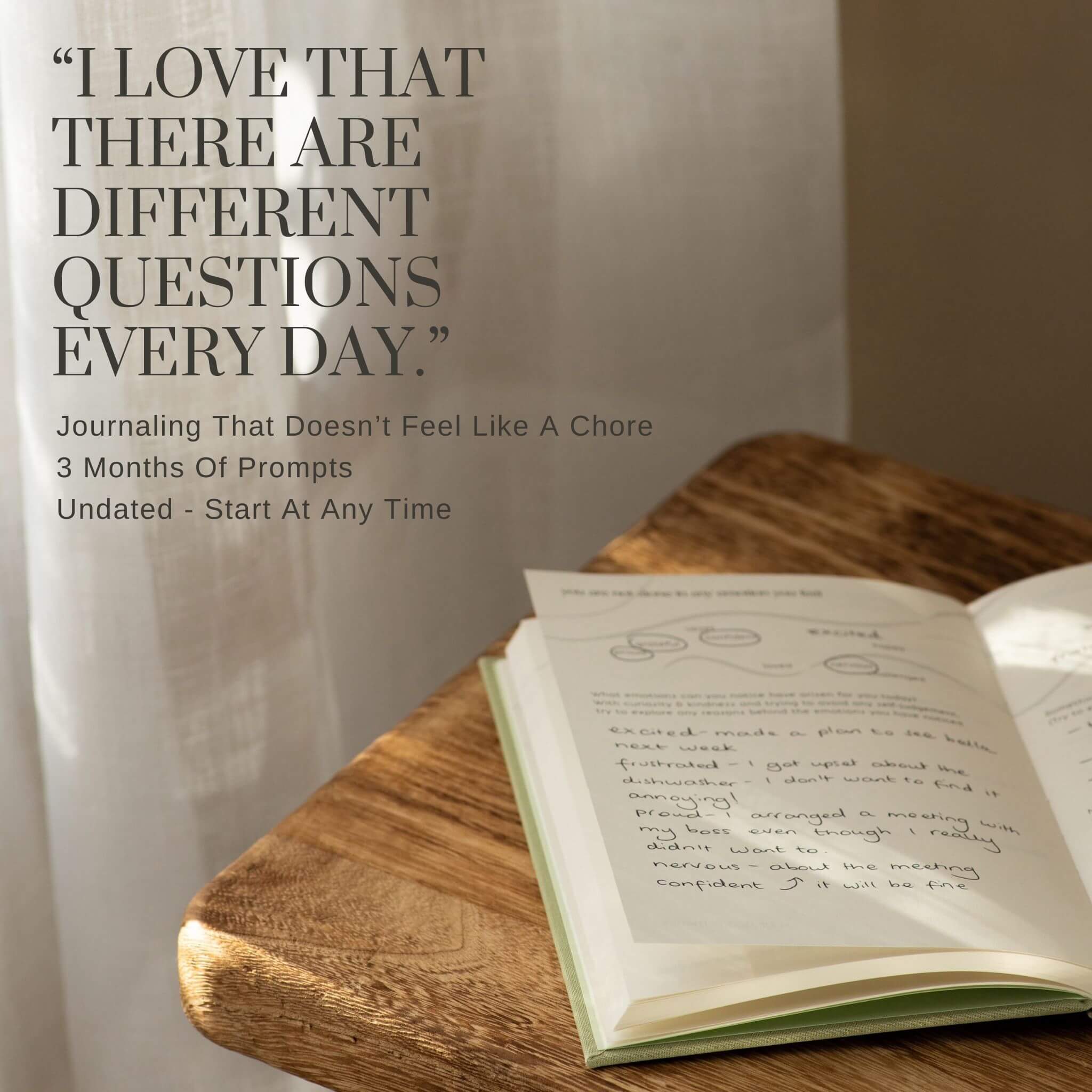
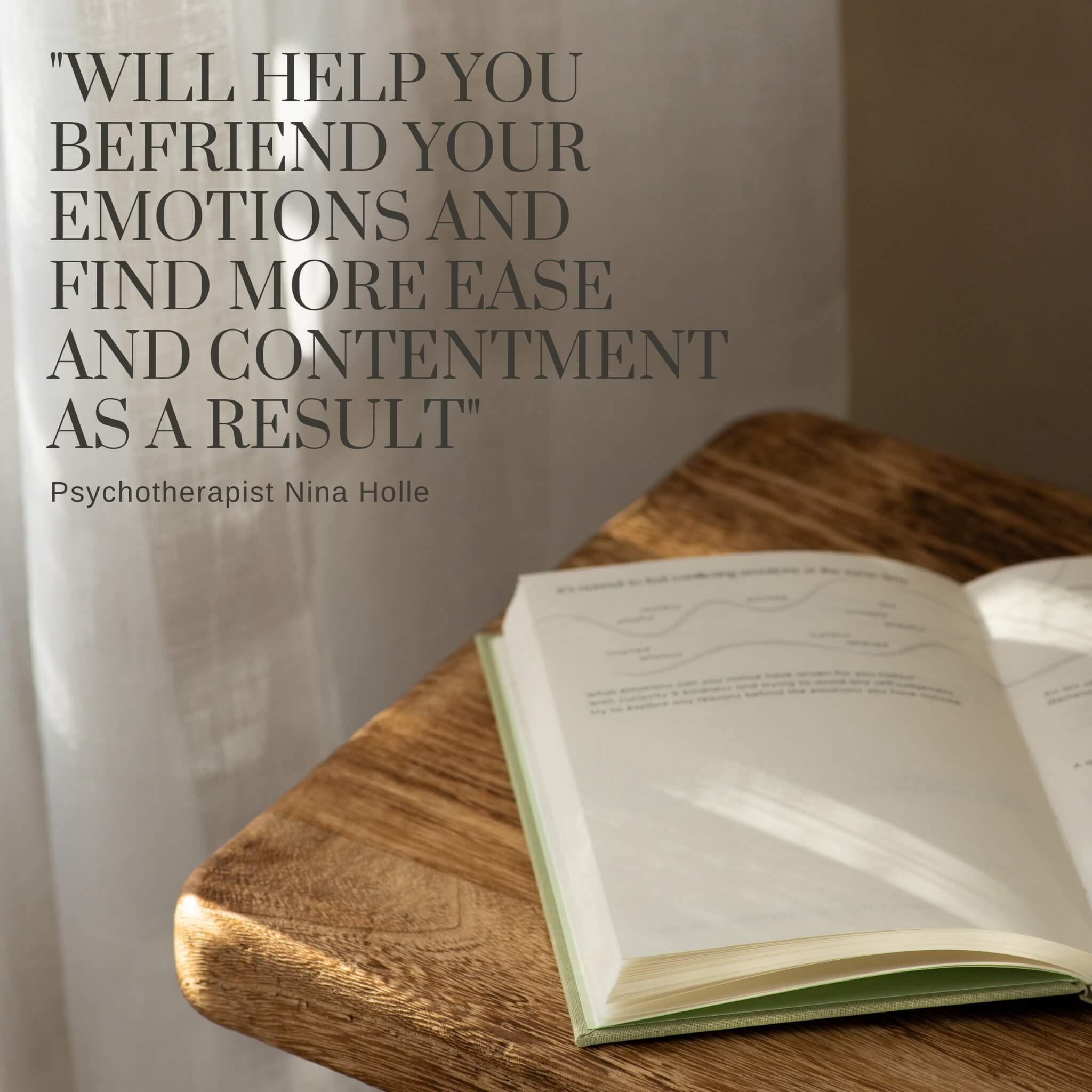
An actual page from my journal, not a stock graphic. The emotion words are arranged differently on every entry, so you're never looking at the same layout twice. Tap the image to enlarge, or see the full journal →

A real page from The Give Yourself Kindness Journal. The emotion words are laid out differently on every entry, so this exact page never repeats.
What to do once you've named it: the 4 A's
Naming a feeling is the middle of the process rather than the end of it. Psychotherapist Nina Holle wrote this four-step approach exclusively for Give Yourself Kindness, and it's the clearest map I know of for what to do with an emotion once you've noticed it. It also has room in it for not knowing, which is why I wanted it here.

-
1Awareness
In the middle of a difficult moment, the first step is simply to pause. Notice what's going on inside. How does your body feel? Your mind? Just notice.
Nothing needs naming yet. This step is only about turning towards what's there.
-
2Allowing
There's often an urge to push a feeling away or make it stop. Nina's advice is not to.
"Think of a chinese finger trap: the harder you pull, the tighter it grips. It's the same with emotions. So the trick is to ease into what you are feeling, to be curious and compassionate with your own emotions."
-
3Assessment
Now you can ask: what am I feeling? Angry? Sad? Scared? If you have more vocabulary to hand, you can look for the nuance: am I angry, frustrated, or outraged? The word list above is there for exactly this.
Nina's note on this step is the part I'd most like you to read:
"If you don't get a sense of what it is that you are feeling, no worries, you can still continue to step 4. Just stay with the sensation in your body."
-
4Action
First, settle yourself. When feelings run high we don't see clearly, and acting from that state is usually something we regret. Nina suggests you might "take a couple of deep breaths, splash cold water in our face or go for a brief walk."
Then, once you feel more like yourself, you can get curious about what the feeling is pointing at.
"Emotions are our most important compass when it comes to leading a healthy and meaningful life... So whenever you feel a strong emotion and have some distance to it you can ask: What does this emotion want me to know? What is this about? What does it need?"
Nina also makes the point that emotions are "clues not conclusions." Sometimes a feeling is about right now, and sometimes it's carrying something older. Journalling can help you tell the two apart, and if something feels overwhelming, she suggests reaching out to a trauma-informed therapist.
If you take one thing from this section: you do not have to know what you're feeling in order to look after yourself. Step 4 is available to you whether or not step 3 goes anywhere. Not knowing is a very ordinary place to be.
5 practical exercises to help you name what you're feeling
These range from quick daily practices to slower explorations. Start with whichever feels manageable, and remember there's no right or wrong way to do this. Turning up gently matters more than doing it perfectly.
1Daily emotion check-in (2 minutes)
What it is: a brief morning or evening pause with a set of emotion words in front of you.
How it works:
- Pick a time that fits your day, morning or evening
- Read through the emotion word list
- Ask yourself: "What can I notice right now?"
- Circle or note two to four of them
- Try not to overthink it, your first instinct is usually worth trusting
Why it can help: regular practice builds emotional vocabulary gently over time. After a few weeks, you might find yourself noticing feelings during the day without needing to look anything up.
Tip: keep the word list somewhere visible, on your fridge, your desk, or as a photo on your phone.
2Body scan for emotions (3 to 5 minutes)
What it is: using physical sensations as a way in when words aren't coming.
How it works:
- Pause and close your eyes, or soften your gaze
- Scan your body from head to toe
- Notice: where do you feel tension? Tightness? Heaviness? Energy?
- Use the body signs guide above to connect physical feelings to possible emotions
- Name what you find: "This tight chest and racing thoughts, that might be anxiety"
Why it can help: emotions live in the body as much as the mind. When words won't come, the body often knows first. It's also Nina's step 4 in practice: you can stay with a sensation without ever putting a name to it.
3Emotion journaling (5 to 10 minutes)Most effective
What it is: a daily practice that brings emotion identification and self-compassion together.
Why this one tends to work best: unlike a brief check-in, journaling leaves you a record over time. You build vocabulary, you start to notice patterns, and you get to practise responding to what you find with kindness, not just naming it.
How it works:
- Have emotion words to hand, so the vocabulary is there when you need it
- Notice two to four emotions, whatever you can find from today
- Write three to five sentences, exploring why you might be feeling them
- Respond with compassion, what would you say to a friend feeling this way?
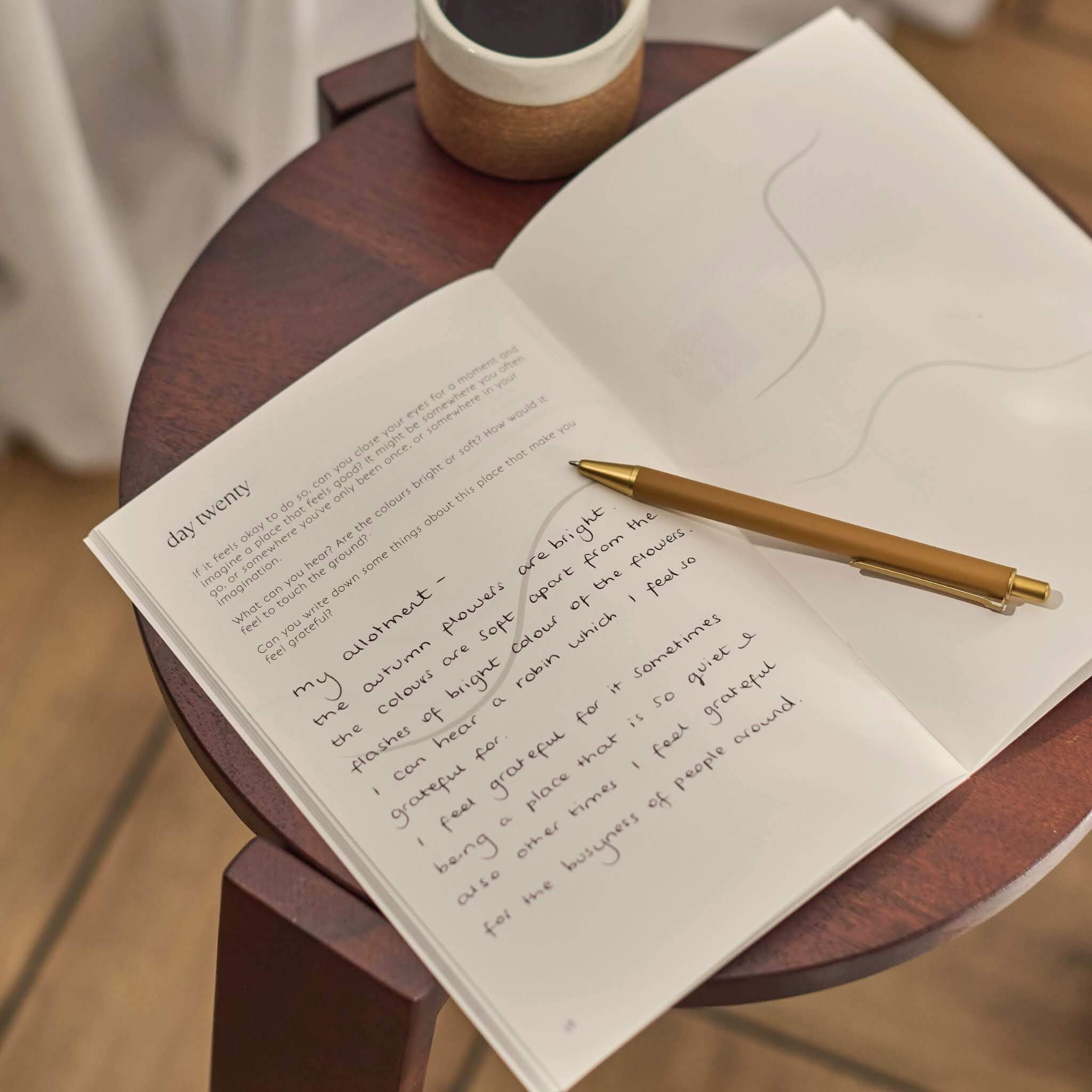
What emotion journaling can look like
When the word won't come at first
Emotions noticed: sad, disconnected, restless
"I feel kind of sad today but I'm not sure why. Nothing particularly bad happened. Reading through the emotion words, maybe it's more like 'disconnected' or 'restless.' Sometimes feelings just show up, and that's okay. I don't have to figure it out or fix it right now. Maybe I just need to be gentle with myself today."
Why this works: naming happened even in the middle of uncertainty. Having the words in front of you made it possible to get more specific than "bad."
Two feelings at once
Emotions noticed: excited, anxious, doubtful
"Starting this new job next month feels exciting and terrifying at the same time. I keep doubting if I'm ready, wondering if I'm going to mess something up. But I also know I wouldn't have gotten this opportunity if I wasn't capable. Both can be true, I can be nervous AND ready."
Why this works: it holds two things at once. As therapist Margaret Davis, MS, LPC puts it in 5 Myths About Emotions, "emotions that seem conflicting can often co-exist together."
Try it yourself
There's no emotion that's "wrong" to feel. Pick two to four words that fit what you're noticing right now (the list above is a good place to start), then write three to five sentences about why. If you can, finish with what you'd say to a friend who felt this way. And if no word fits, writing "I don't know, but something feels off" counts.
That's the whole practice, and it's the same one behind the real journal page you saw earlier. If it felt useful, the Give Yourself Kindness Journal gives you a new page like it every day, with a fresh spread of emotion words each time. If you'd rather see how it compares to the other options first, including the free ones, here's the honest comparison.
4Pattern tracking (weekly review)
What it is: looking back over your week to see what keeps coming up.
How it works:
- At the end of each week, read back over your check-ins or journal entries
- Look for patterns: when do certain feelings show up most?
- Notice what tends to bring them: which situations or conversations?
- Notice the good too: what brought you joy, peace, or contentment?
Why it can help: single moments of noticing are useful, but patterns tell you more. After a few weeks you may start to see things like "I'm more irritable when I haven't slept well" or "Talking to my sister lifts my mood."
5The "friend perspective" exercise (as needed)
What it is: borrowing a little kind distance when a feeling is hard to look at directly.
How it works:
- Notice the moment a feeling arrives with criticism attached to it
- Ask: "If a friend was feeling this way, what would I think they're experiencing?"
- Name it for them: "They seem really hurt" or "They sound overwhelmed"
- Offer yourself the same clarity: "I'm feeling hurt" or "I'm overwhelmed"
Why it can help: it's often easier to see a feeling clearly in someone else. Margaret Davis's fifth myth is exactly this, the belief that "I should be feeling differently about this," and her invitation is to meet the feeling "with curiosity, rather than criticism."
A journal built around finding the words
Everything above this point is free, and you're welcome to it whether or not you ever buy anything from me. This section is about the journal, so you know exactly what it is before deciding.
Most journals open with "How do you feel?" and leave you to find the word on your own. This one puts the words in front of you first. Every page offers a fresh spread of emotion words to choose from, a new prompt to get curious about why, and room underneath to answer yourself the way you'd answer a friend. Ninety entries, undated, so you can pick it up when you need it rather than having to keep up with it. There's no right or wrong way to fill it in.
- 90 unique prompts
- A fresh emotion-words layout every page
- Undated format
- Research-backed
- 58+ five-star reviews
- Used by therapists worldwide




£28.95
Free UK delivery on orders over £35. Duties and taxes are prepaid for US orders, so there are no surprise charges on arrival.
- 90 unique prompts, with a different emotion-words layout on every page
- Undated format, so there's no guilt when you miss days
- Recommended by clinical psychologists from Harvard Medical School and Oxford
- Used by therapists with clients in over 30 countries
Added to your basket. View basket →
This might be for you if you'd like to
- have the words in front of you rather than searching for them
- understand what you're feeling, not just record what happened
- have something to use between therapy sessions
- try journalling for the first time, with the questions already written
- come back to it after a gap without feeling behind
Where something else may suit you better
- If you want charts, streaks and reminders. This is paper. It won't nudge you, and it can't show you a graph of your month. A mood-tracking app does that better, and many are free.
- If you want emotion tracking and nothing else. There are gratitude and self-compassion prompts in here too, which some people love and some find is more than they were after.
- If you're in DBT. Use the diary card your therapist asks for. Free printables are widely available.
What makes it work for finding the right word
- Emotion words on every single page. Not just at the front, on all 90 pages, so they're there at the moment you need them.
- Prompts that explore, not just name. Each day invites you to get curious about why you're feeling what you're feeling.
- Self-compassion built in. Based on research suggesting that how you respond to a feeling matters as much as naming it.
- 90 unique prompts. Each entry comes at emotions from a different angle, so it stays interesting rather than becoming autopilot.
- Undated format. No guilt when you miss days, because life happens.
I've written an honest comparison of this journal against DBT diary cards, mood-tracking apps and plain blank notebooks, including the free ones and when each of them makes more sense than mine. If you're weighing things up, start there rather than here.
One honest note: this journal is a self-guided tool, not a diagnosis or a replacement for therapy. If naming your emotions stays very difficult even with practice, that's worth exploring with a professional. There's a section on that below.
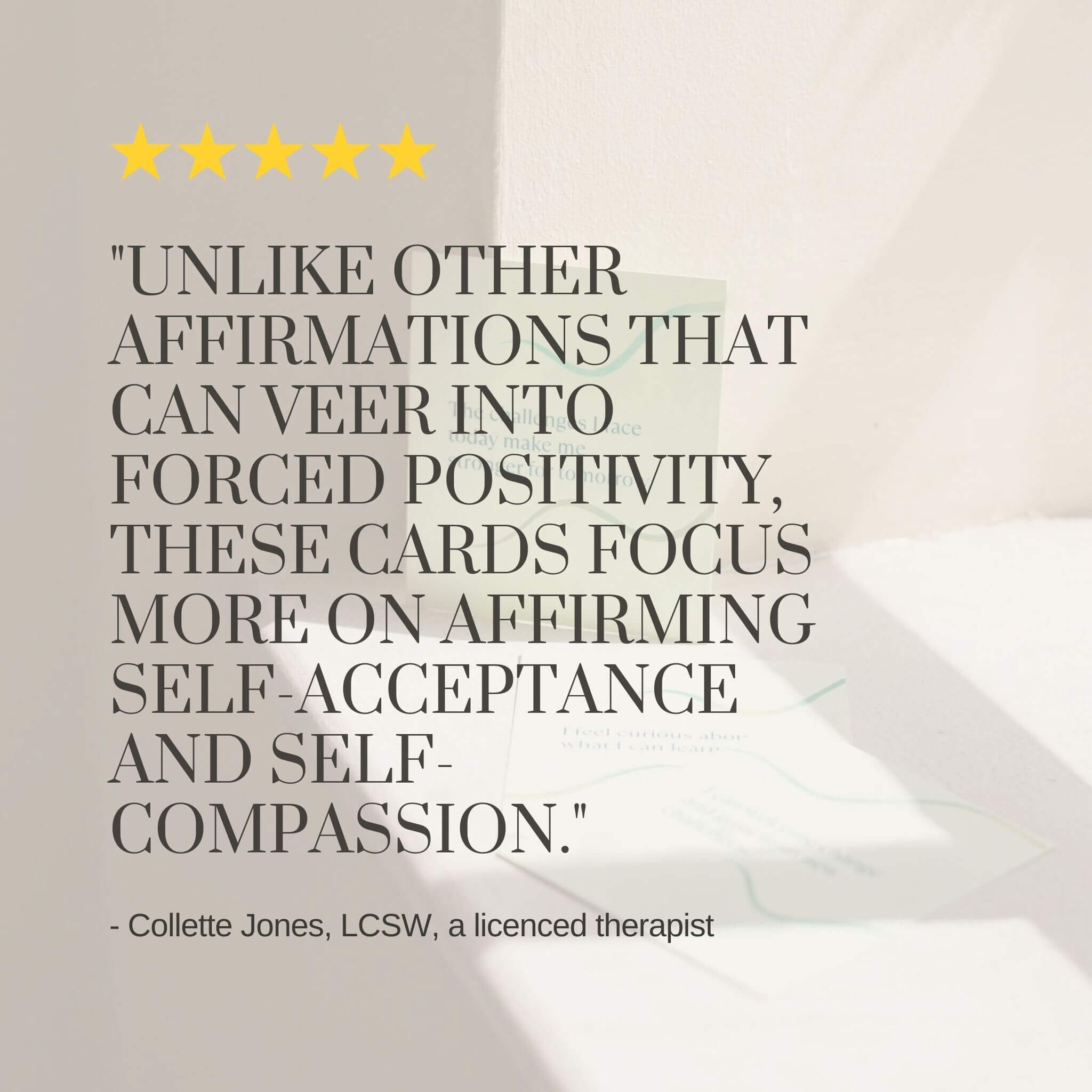
What mental health professionals say
These are reviews from clinicians who use the journal with their own clients. Tap any one to read the full set of expert reviews.
Dr. Chris Germer, PhD
Clinical Psychologist, Harvard Medical School. Co-developer of Mindful Self-Compassion
"A warm invitation to make friends with your emotions and yourself!"
 Professor Willem Kuyken, PhD, DClinPsy
Ritblat Professor of Mindfulness, University of Oxford. Top 1% most cited scientists worldwide
"The journal is rooted in state-of-the-art research that emphasizes the importance of understanding our emotions in order to lower stress and lead a happy and meaningful life. Rachel has curated the experience to make the writing intrinsically rewarding and the journal something to treasure."
Professor Willem Kuyken, PhD, DClinPsy
Ritblat Professor of Mindfulness, University of Oxford. Top 1% most cited scientists worldwide
"The journal is rooted in state-of-the-art research that emphasizes the importance of understanding our emotions in order to lower stress and lead a happy and meaningful life. Rachel has curated the experience to make the writing intrinsically rewarding and the journal something to treasure."
 Carrie Pollard, MSW RSW
Experienced Psychotherapist
"Being able to identify what you're feeling and compassionately explore the 'why' is central to self-connection and self-growth. The Give Yourself Kindness journal is a steady guide in this process. It helps you name and process your emotions, identify what you need to cope, and give yourself the same compassion you would a loved one. This is by far my favourite guided journal that I've used!"
Carrie Pollard, MSW RSW
Experienced Psychotherapist
"Being able to identify what you're feeling and compassionately explore the 'why' is central to self-connection and self-growth. The Give Yourself Kindness journal is a steady guide in this process. It helps you name and process your emotions, identify what you need to cope, and give yourself the same compassion you would a loved one. This is by far my favourite guided journal that I've used!"
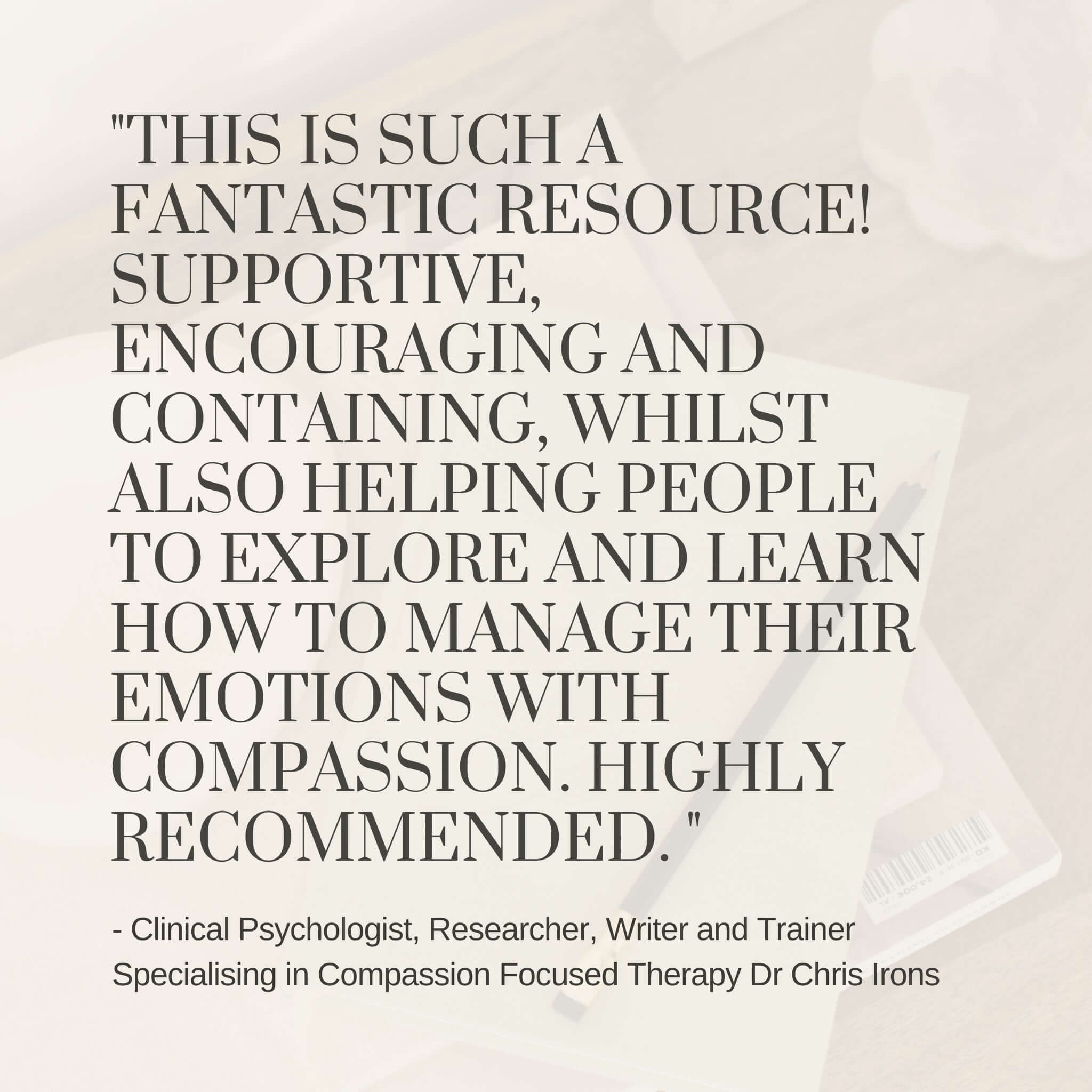
 Dr. Chris Irons
Clinical Psychologist. CFT Researcher and Trainer
"Supportive, encouraging and containing, whilst also helping people to explore and learn how to manage their emotions with compassion. Highly recommended."
Dr. Chris Irons
Clinical Psychologist. CFT Researcher and Trainer
"Supportive, encouraging and containing, whilst also helping people to explore and learn how to manage their emotions with compassion. Highly recommended."
Expert-written resources on understanding emotions
These articles were written for Give Yourself Kindness by licensed therapists and psychologists who specialise in emotions. They go deeper into some of the places people most often get stuck. All of them are free to read.
Nina Holle
Psychotherapist and writer, drawing on psychology, neuroscience and various wisdom traditions
Author: "How to Embrace Your Emotions: the 4 A's"
What this article covers: the full version of the four-step approach above, plus why fighting a feeling tends to tighten its grip, how to self-regulate before you act, what it means to treat emotions as "clues not conclusions", and how to investigate a feeling that seems to belong to something older.
"Emotions are the most wonderful thing about being human. And the most challenging."Read: How to Embrace Your Emotions →

Dr. Kristin Neff, PhD
Associate Professor of Educational Psychology, University of Texas at Austin. Developed the first scale to measure self-compassion, more than 20 years ago
Author: "Being With Difficult Emotions"
What this article covers: the techniques Mindful Self-Compassion uses for painful feelings, including labelling, finding the emotion in the body, and the soften-soothe-allow practice. It's the clearest explanation I know of why naming a feeling works at all.
"Naming or labeling difficult emotions helps us to disentangle, or 'unstick,' from them. If we can say, 'This is sadness' or 'Fear is arising,' we get perspective on the emotion rather than being engulfed by it. This gives us some emotional freedom. Name it and you tame it."Read: Being With Difficult Emotions →

Margaret Davis, MS, LPC
Licensed Therapist specialising in anxiety, relationships, self-esteem, and self-compassion
Author: "5 Myths About Emotions"
What this article covers: the common misconceptions that make naming emotions harder than it needs to be, including why suppression backfires, why all emotions are valid, the problem with intellectualising, why conflicting emotions coexist, and how self-judgment adds to the suffering.
"All of our emotions are okay. We have a broad range of emotions over a large spectrum, and each of them are welcome. We don't have to label an emotion as good or bad. Instead, it can simply be what it is, without any judgment from ourselves."Read: 5 Myths About Emotions →

Dr. Laura Berssenbrugge
Licensed Clinical Psychologist, DBT Specialist. Expertise in anxiety, OCD, emotion regulation, and stress-related disorders
Author: "Riding the Wave of Emotions"
What this article covers: once you've named a feeling, what do you do with it? Dr Berssenbrugge explains Dialectical Behaviour Therapy's Opposite Action technique, the 5-step process, specific approaches for sadness, anger, fear, guilt and shame, and when acting opposite to an urge may serve you better than following it.
"By intentionally acting in opposition to the impulse fueled by the emotion, Opposite Action provides a way to disrupt harmful behavioral patterns. The next time you find yourself riding an emotional wave, remember: you have the power to choose your response."Read: Riding the Wave of Emotions →
What if you really can't identify any emotions?
For some people, naming a feeling stays extremely difficult even with practice and tools. If that sounds like you, you might be experiencing something called alexithymia.
What is alexithymia?
Alexithymia is difficulty identifying and describing emotions. It isn't a mental health disorder, but it can co-occur with anxiety, depression, autism, ADHD, and PTSD. Signs you might experience alexithymia include difficulty telling emotions apart from physical sensations, limited ability to describe feelings to others, difficulty naming what you're feeling even when you know something is off, and a tendency to focus on external events rather than internal experience.
If you think this applies to you
- Start with body sensations. If a word won't come, start with what's physical. "My chest is tight" is a perfectly valid starting point.
- Work with a therapist, especially one trained in somatic therapy, DBT, or Compassion-Focused Therapy. They can help you build this gradually.
- Be gentle with yourself. For some people this is genuinely harder. That doesn't mean anything is wrong with you, it means you deserve more support.
- Keep emotion words in front of you. Even when it feels mechanical, regular exposure to the vocabulary helps your brain build the connections over time.
Please note: if you're struggling significantly with identifying or managing your emotions, please do work with a qualified mental health professional. These exercises are supportive tools, and they're not a replacement for therapy when you need more support.
Common questions about identifying emotions
How long does it take to get better at identifying emotions?
Many people find it starts to feel a little easier within a few weeks of regular practice. You might notice feelings during the day rather than only when you sit down to write, catch them a bit earlier, and reach for more specific words without thinking about it. Over a few months it often becomes more automatic. But please be patient with yourself. This is a real skill, and it takes as long as it takes.
What if I read through the emotion words and still can't name what I'm feeling?
This is completely normal, especially at the beginning. First, try body sensations instead: notice where you feel something physically, then use the body signs guide to connect it to possible emotions. Second, start with the broad headings of sad, angry, anxious, hurt, ashamed, overwhelmed, flat, happy or calm, and see which feels closest, even if it isn't quite right. Third, it's absolutely fine to write that you're not sure but something feels off, because that's still real awareness. It does tend to get easier.
What should I do if I feel nothing at all?
Feeling flat, blank or numb is itself information, and it's more common than people expect. You don't have to force a feeling to appear. Psychotherapist Nina Holle's approach makes room for this: if you can't get a sense of what you're feeling, you can move on to looking after yourself anyway and simply stay with whatever sensation is in your body. Being gentle with yourself doesn't require you to name anything first.
Can you feel multiple emotions at the same time?
Yes, and this is completely normal. As therapist Margaret Davis, MS, LPC explains in her article 5 Myths About Emotions: maybe we are trying something new and it feels both exciting and scary at the same time. Or we made a tough decision for ourselves and might feel both relieved and sad at the same time. Emotions that seem conflicting can often co-exist together.
Is it normal to not know why I feel a certain emotion?
Absolutely. Sometimes feelings arrive without a clear trigger, and that's okay. You don't always need to know why to benefit from naming what. Simply noting that you feel sad right now can help settle the feeling, even if you're not sure what brought it. Sometimes the why becomes clear later, and sometimes it doesn't. Both are fine.
What's the difference between a feeling and an emotion?
In everyday use the two words are interchangeable, and nothing on this page depends on telling them apart. Where people do draw a line, emotion usually refers to the automatic response in the body and brain, and feeling refers to your conscious experience of it once you've noticed it. Naming is what turns one into the other, which is really the whole point of this page.
What is an emotion wheel, and do I need one?
An emotion wheel is a circular chart with broad feelings in the centre and more specific ones radiating outwards, designed to help you move from a general word to a precise one. It's a useful format, and you don't need that particular shape to get the benefit. What matters is having a wider set of words in front of you rather than searching your memory, which is why this page gives you a plain list you can read down and photograph.
Should I try to change or fix emotions after I identify them?
Not necessarily. The point of naming a feeling is understanding, not elimination. Once you've named it, you might ask whether it's pointing to something you need. If it is, you can act on that. If not, you can practise letting it be there without judgment. Dr Laura Berssenbrugge's article Riding the Wave of Emotions goes into more detail on responding skilfully to different emotions.
Do I need to journal to identify emotions, or are the other exercises enough?
You don't need to journal. It does tend to be the most effective practice for building lasting skill, because it gives you consistent practice, a record to spot patterns in, self-compassion built into the process, and room to explore. But brief exercises like the daily check-in help too, and anything you'll actually do is better than the perfect practice you won't.
Is there a free way to do this?
Yes, and I'd rather you started than waited until you'd bought something. The word list, the body signs guide, the 4 A's and all five exercises on this page are free and always will be, and every expert article linked here is free to read. Any notebook works. My journal exists because having the words printed on the page you're writing on removes a step, not because you can't do this without it.
What's the difference between identifying emotions and ruminating about them?
Identifying an emotion is noticing and naming: I feel disappointed right now. Ruminating is repetitive thinking that doesn't lead anywhere: why do I always feel disappointed, what's wrong with me? Naming has a quality of curiosity and acceptance to it. If you notice yourself sliding into self-criticism, that's rumination, and you can gently come back to simply naming what's there.
I have alexithymia, will these exercises still help?
They may, though progress can be slower, so please be patient with yourself. Start with body sensations, exercise 2 above, since physical feelings are often more accessible than emotion words. Keep reading through emotion words regularly, even when it feels mechanical. And most importantly, work with a therapist trained in somatic approaches or DBT who can support you with this as part of your treatment.
If you'd like something to write in
90 unique prompts. A fresh spread of emotion words on every page. No right or wrong way to use it.
Discover The Give Yourself Kindness Journal →Continue reading
"The harder you pull, the tighter it grips. It's the same with emotions."
Nina Holle · How to Embrace Your Emotions →
"Name it and you tame it," why labelling a difficult feeling loosens its grip.
Dr Kristin Neff, PhD · Being With Difficult Emotions →
"We don't have to label an emotion as good or bad. Instead, it can simply be what it is, without any judgment from ourselves."
Margaret Davis, MS, LPC · 5 Myths About Emotions →
"You have the power to choose your response," the Opposite Action technique for working with difficult emotions.
Dr Laura Berssenbrugge · Riding the Wave of Emotions →A full, honest comparison of the Give Yourself Kindness Journal against DBT diary cards, mood-tracking apps and blank notebooks, including the free options and when each one makes more sense than mine.


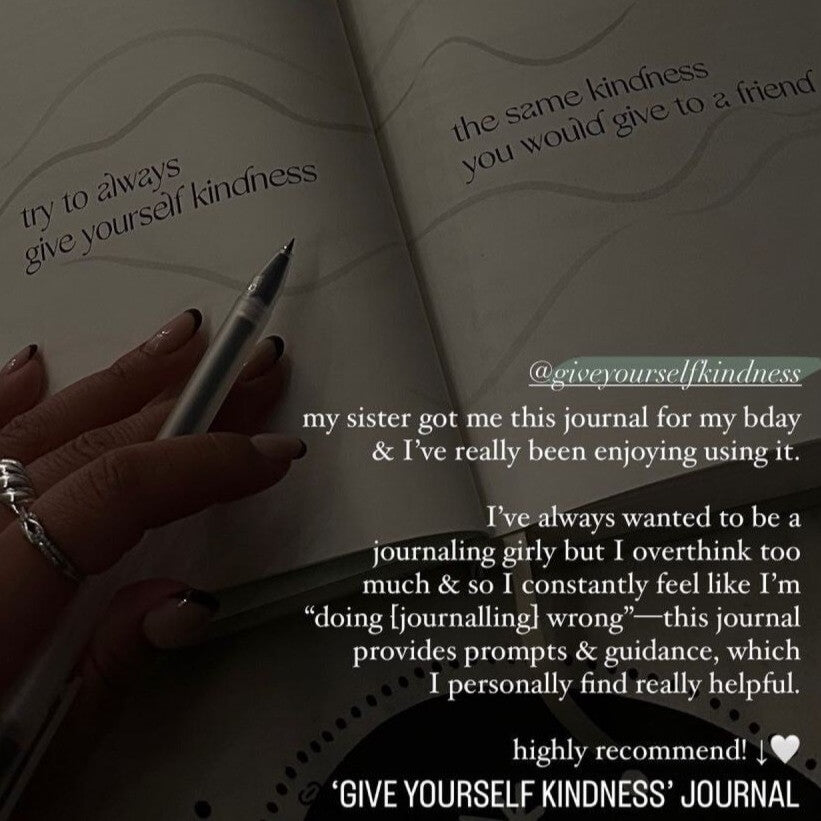
“By far my favourite guided journal that I’ve used!”
There's a lot of journals out there. Most of which include tools that can be repetitive, boring or unhelpful. Give Yourself Kindness is about creating something new.