

Self-Care When You Don't Feel You Deserve It
Quick answer
You do not have to feel you deserve self-care before you are allowed to have it. Rest is not a reward for having done enough, and needing it is not a weakness. Clinical psychologist Dr Michelle Chung puts it plainly: rest is not the enemy of success; it is its foundation. Waiting until you have earned a break does not work, because the standard for having earned it is set by the same voice that is refusing you the break. Start smaller than that argument, and you might find the question starts to lose its grip.
 Dr Michelle Chung, Clinical Psychologist, on mindful self-care. Read her full article
Try this now: Dr Chung’s 60-second self-care challenge, which asks nothing of you except a minute.
- Sit still and breathe.
- Notice the sensations in your body.
- Notice the environment around you.
- Notice one thing you are grateful for.
That is it. Not a two-hour yoga class, not a spa day, not something you have to schedule. And if a minute of sitting still felt restless, or felt like time that should have gone on something else, that is a very ordinary reaction rather than a sign this is not for you.
Wanting to look after yourself is a kind thing to want, and looking for a way in is a good place to be starting from. This page is about the bit that comes before the bath and the early night: the sense that you specifically are not allowed to need either.
I have felt a good deal of it myself — that stopping had to be earned, and that needing to stop said something about me. You can read this in any order, including going straight to the one-minute practices if that is what you need first.
About this guide. I am Rachel Smith, founder of Give Yourself Kindness and a qualified meditation teacher (DipBSoM, British School of Meditation, distinction). I am not a psychologist or a therapist. Everything clinical on this page comes from named clinical psychologists, with their credentials and a link to the full article they wrote for this site, so you can read their words for yourself.
What self-care actually means here
Self-care is not a category of nice things you buy. It is whatever keeps you functioning, and most of it is very small and costs nothing. That matters on this page, because if self-care sounds like an afternoon you do not have and a budget you have not got, of course it feels like something you have not earned.
Dr Michelle Chung, a clinical psychologist, opens her article for this site by naming exactly that problem.
Dr Michelle Chung
Clinical Psychologist | Specialises in anxiety-related disorders, trauma, mood disorders and ADHD | Trained in CBT and DBT | Head of her own private practice
Read Dr Chung’s full article: the art of mindful self-care →“In a world that demands so much of us, self-care often feels like an elusive luxury—something we promise to get to, only to find it sidelined by a busier-than-ever schedule. But what if we could shift our perspective? What if self-care didn’t require a two-hour yoga class, a tropical retreat, or even an uninterrupted evening? What if self-care could be found and fully embraced in the tiniest moments?”
People usually mean one of three things by the word, and they are not in competition. It is only worth separating them because the third one is the one that tends to go missing, and it is also the one that asks nothing of your diary or your bank account.
- The lovely version. The bath, the candle, the massage, the good coffee. Genuinely nice, and there is nothing wrong with wanting it. It is just not usually the part that is missing.
- The maintenance version. Sleep. Food that is actually food. A drink of water. A walk outside. Seeing a doctor about the thing that has been waiting. Unglamorous, and the part that keeps you upright.
- The one-minute version. A pause. A breath before the next meeting. Noticing the sunlight for a second. Dr Chung calls this bang for your buck self-care, and it is available on the worst day you will have this year.
The version of self-care that helps most takes a minute and costs nothing, which means a shortage of time and money is not what is standing in the way.
Dr Chung describes those small pauses as going into a reserve — an investment in your resilience, building a foundation one moment at a time. Not a treat at the end of a good week. Something you top up as you go, in the same way you eat lunch without asking whether you have earned lunch.
One word you will see on this page, in plain English
You do not need to know anything about psychology to use any of this, and I am not going to assume you do. But there is one term worth having, because it names the exact thing that gets in the way.
Self-compassion just means treating yourself roughly the way you would treat someone you cared about who was going through the same thing. That is all it is. Not talking yourself up, not pretending things are fine — just responding to your own difficulty with some understanding rather than a telling-off.
It matters here because self-care is the doing, and self-compassion is the permission. Someone can know perfectly well that they should eat something and go to bed, and still not do it, because some part of them has decided it has not been earned. That part is what the rest of this page is about.
One last thing from Dr Chung before I move on, because it answers the objection most people raise first — that looking after yourself takes something away from the people who need you.
Dr Michelle Chung
Clinical Psychologist | Head of her own private practice | Writing for Give Yourself Kindness
Read the full article on mindful self-care →“For my clients, I often say: Your ability to show up for others is only as strong as your ability to show up for yourself. When you’re fully present—whether it’s for a client, your child, or yourself—you give a gift that no amount of time or effort could replace.”
Why you feel you do not deserve self-care
Needing to look after yourself is not weakness. It is a fact about being a person, and it does not become negotiable because you are the person in question. If you are here, some version of the opposite may have been running for a long time — and it is worth saying plainly that it is a belief picked up somewhere, not a description of how bodies work.
When people describe this to me, it usually arrives in three parts. They tend to come together, and each one props up the next.
I do not deserve to rest
Rest is treated as something to be paid for. Not enough has been done today, so the sitting down has not been earned, so it does not happen — or it happens and is not restful, because it is being audited the whole time.
I have to keep doing
Stopping feels dangerous rather than pleasant. As long as the doing continues, something is being held together. The idea of putting it down is not appealing, it is frightening.
Needing rest is weakness
Other people are allowed to be tired. Your own tiredness reads as a defect — evidence that you are not managing what you should be able to manage, and that other people are somehow doing it without needing what you need.
If you recognised yourself in those, the first thing worth knowing is that the belief underneath them is simply wrong about how people work. Dr Michelle Chung sees this constantly in her practice, and answers it in one line.
Dr Michelle Chung
Clinical Psychologist | Specialises in anxiety-related disorders, trauma, mood disorders and ADHD | Trained in CBT and DBT
Read Dr Chung’s full article: the art of mindful self-care →“In my practice, we often meet individuals driven by the need to achieve, to perform, to do. But what if rest, reflection, and stillness were also forms of productivity? In these quiet spaces, creativity blooms, resilience builds, and clarity emerges. Because rest is not the enemy of success; it is its foundation.”
Rest is not the enemy of success; it is its foundation. If you only take one sentence from this page, that is the one.
The second thing worth knowing is that this difficulty is not unusual, and it is not a private defect. It is common enough that it has a name in the clinical literature, and common enough that psychologists built a questionnaire to measure it.
The fear of being fundamentally unworthy of it
Feeling unworthy of care is one of the ten most common fears of self-compassion, and it is recognised and described in Compassion Focused Therapy. Dr Chris Irons, one of the world’s leading researchers and trainers in CFT, wrote about these fears for this site. Number seven on his list is this one.

Dr Chris Irons, DClinPsy
Clinical Psychologist | Compassion-Focused Therapy researcher and trainer | Co-director of Balanced Minds | Trained at the University of Sheffield, with many years in the NHS
“Many people feel fundamentally unworthy of compassion. This can be related to deep-seated feelings of shame and self-loathing that can either make the idea of self-compassion seem impossible, and only reserved for other people who don’t have problems or flaws.”
What this means here: read that last clause again, because it is the part that tends to land — only reserved for other people who don’t have problems or flaws. That is the shape of the belief. Care is available to people who are already fine, and having problems disqualifies you from the thing that exists for people with problems.
Read Dr Irons’ full article: the 10 common fears of self-compassion →Put like that, it does not hold up. It did not feel like an argument while it was running silently — it felt like a fact.
There is a scale for this, which tells you how ordinary it is
Dr Irons notes that colleagues of his developed the Fear of Compassion Scale in 2011. It has three subscales: the fear of compassion for others, the fear of compassion from others, and the fear of self-compassion. As he puts it, you know something is common in life when a psychologist develops a questionnaire to measure it.
Research using it has found that people who score higher on fear of self-compassion tend to have higher levels of mental health difficulties, along with higher levels of shame and self-criticism. That is worth knowing for one specific reason: it means this is a described, studied thing with a name, rather than something wrong with you specifically.
His other nine fears are worth reading too, because people often find theirs is not the one they expected. In his article they are: laziness, weakness, emotional overwhelm, sadness or grief, loss of control, emptiness, unworthiness, losing self-criticism, selfishness, and self-compassion as self-pity.
Dr Irons credits the Fear of Compassion Scale to Professor Paul Gilbert, the developer of Compassion Focused Therapy, and colleagues, 2011.
On the specific fear that looking after yourself is weakness
Taking care of yourself is not a sign of weakness, and neither is needing to. Dr Irons lists the fear of weakness second — the worry that being kind to yourself will make you vulnerable or less resilient, that it is softness, or being, in his phrase, wishy washy. He answers it with an example that turns the whole thing over.
Dr Chris Irons, DClinPsy
Clinical Psychologist | Compassion-Focused Therapy researcher and trainer | Co-director of Balanced Minds
Read more on the fears, in his own words →“If you think about a firefighter, they embody much of what we in CFT would hold as compassion... would you say that they are typically weak, lazy or selfish? Well, no, not at all. In fact, what you’re far more likely to do is describe them as brave, courageous and strong.”
Looking after yourself has two parts. Noticing that you are struggling and being willing to stay with that, and then doing something about it. Neither of those is the soft option. Turning towards your own exhaustion and then acting on it takes more nerve than overriding it does.
Overriding is easier. It is familiar, it is often rewarded at work, and it means never having to find out what is underneath the tiredness. Stopping is the harder thing.
Why waiting until you have earned self-care never works
The reason waiting never works is that the standard moves. Whatever counts as having done enough is set by the same voice that is refusing you the break, and that voice adjusts. Meet the bar and it rises. This is not a willpower problem and nobody is failing at it — it is a system with no exit built into it.
So the move is not to argue your way to a yes. It is to notice that the question was never part of the deal.
Nothing about looking after yourself requires you to have earned it first. Dr Chris Irons sets out the definition used in Compassion Focused Therapy as a sensitivity to the suffering of self and others, with a commitment to relieve and prevent it. He describes it as holding two related but separate parts:
- The ability to notice, engage with, tolerate and understand distress and suffering, whether in yourself or in someone else.
- The ability to take wise action to relieve that distress where possible, and to take steps to prevent it returning.
There is no third part about whether the person suffering has earned it. The test is that suffering is present, and that something can be done about it. That is all.
Put in the language you would actually use: you are tired, and there is something small you could do about it. That is the whole qualifying criteria.
This is also, I think, why a lot of advice on this subject bounces off. It asks you to recognise your worth first, and to look after yourself as a consequence. That puts a verdict on yourself in front of the rest, which is exactly the door that will not open.
You do not have to think well of yourself to look after yourself
Feeling good about yourself and being kind to yourself are two different things, and only one of them needs settling first. That distinction is the practical way round this, and it is worth thirty seconds.
The question that blocks you
It needs a verdict first
- Am I good enough?
- Have I done enough today?
- Do I compare well?
- Have I earned this?
The question that gets you moving
It can be answered on a bad day
- Is this hard right now?
- What do I need?
- What would help rather than harm?
- What would I do for someone else in this state?
Every question on the left needs an answer before anything happens, and on a bad day none of them get one. Every question on the right can be answered honestly while you still feel terrible about yourself. That is the whole practical advantage, and it is why the right-hand column is the one this page keeps coming back to.
If the broader practice of being kinder to yourself is what you are after, rather than this particular block, I have written it up properly over on how to be kinder to yourself — ten practices, and what to do when the kindness will not go in.
Is self-care just self-indulgence?
No — and the difference between the two is not how nice something feels, it is what it is aimed at. This is the objection that stops a lot of people from doing anything at all, and Dr Kristin Neff, who developed the theory and the scale used to measure self-compassion, draws the line more usefully than anyone.

Dr Kristin Neff, PhD
Associate Professor of Educational Psychology, University of Texas at Austin | Developed the theory and the scale used to measure self-compassion
“If we truly care about ourselves, we won’t engage in feel-good behaviors that are bad for us. Self-indulgence involves choosing short-term pleasure at the expense of long-term harm, and self-compassion always has its eyes on the prize: alleviating suffering.”
What this means in practice: the example Dr Neff works through points the opposite way to the one people expect. Turning the alarm off and going back to sleep might be the indulgent choice — the temporary pleasure of slipping into a slumber once more, as she puts it, when getting to work late will have consequences. The properly caring choice in her example is not the lie-in. It is going to bed earlier, so that there is enough rest to begin with.
Read Dr Neff on self-compassion or self-indulgence →A test you can apply in about ten seconds
If you are unsure whether something is genuine self-care or avoidance, the feeling will not tell you. Comfort and avoidance are indistinguishable from the inside. Ask this instead:
- Does this move me towards something I care about, or away from it?
- Will I be glad of it tomorrow, or only right now?
- Is it what I would recommend to someone I loved who was this tired?
Going to bed passes all three. Scrolling until two in the morning because tomorrow feels unfaceable does not. Notice that the second one is also not a moral failure — it is usually what happens when the first one has been refused for long enough.
But if I stop pushing myself, will I stop altogether?
Looking after yourself does not lower your standards. It changes what you are using to reach them. This is the fear underneath a lot of the refusing — that the driving is load-bearing, and that removing it means the whole thing comes down. It is worth taking seriously rather than waving away, because it has usually been believed for a long time and it has never been tested.
Dr Bianca Nardini, a London clinical psychologist who works with people experiencing anxiety and self-criticism, writes about this directly. In her experience, when people are asked what worries them about giving up their inner critic, most say some version of the same thing: that they will let themselves off the hook, lower their standards, and fail as parents, workers or partners.

Dr Bianca Nardini
Clinical Psychologist, London | Specialises in helping people who experience anxiety and self-criticism
Read Dr Nardini’s full article: why is self-compassion so hard? →“The path to self-compassion isn’t about lowering your standards. It’s about changing your approach to meeting those standards—using encouragement rather than punishment as your primary tool.”
Her way into this is a scene about hiring a coach for a friend running a marathon — one who shouts, one who encourages — and asking which one you would pick for someone you loved. The answer is instant when it is for somebody else. I have written that story up in full on the kinder-to-yourself page, and it is worth two minutes if you have not come across it.
What I would add from my own side of this, and only from my own side: I believed the harsh voice was what kept me functioning. That if I eased off I would get sloppy, and the criticism was the price of being any good at anything.
It took my own experience of Compassion-Focused Therapy to work out that it was not doing what I thought it was doing. It was not making me careful. It was making me frightened, and frightened is a poor state to work in and an even worse one to rest in.
What to say when kindness to yourself feels like a lie
Avoid anything that starts with I am worthy or I deserve this, because a statement you do not believe invites an argument you will win. Specialist clinical psychologist Dr Jeffrey McDonnell makes the same point about positive self-statements generally.

Dr Jeffrey McDonnell
Specialist Clinical Psychologist, London | Former research and teaching fellow at University College London
“Research suggests that for some people, positive self-affirmations can be helpful but for others, they may be ineffective or even harmful (particularly for those who may already struggle with low self-esteem).”
Dr McDonnell cites Wood, Perunovic & Lee (2009), “Positive self-statements: Power for some, peril for others”, Psychological Science.
Read Dr McDonnell’s full article: do affirmations really work? →What tends to work instead is a description rather than a declaration — something factually true that your critic has no grounds to attack. This is hard right now is not a claim about your worth. It is a report on the weather.
These five are the moments people describe to me most often, and they are all about the same thing: rest, stopping, and the sense that you specifically are not allowed to need either. Read the left-hand line first, then try the kinder version in those exact words, borrowing the wording until your own arrives.
When you finally sit down and immediately feel you should be doing something
The critic: “You have not done enough today to be sitting here. Get up.”
Kinder: “I am tired, and tired is a real state rather than an excuse. I do not have to finish the list to be allowed to stop. Sitting down is maintenance, not a reward.”
When you are running on empty and the list is not finished
The critic: “Everyone else manages this. If you cannot, that says something about you.”
Kinder: “I am comparing what I know about my own week to what I can see of theirs, which is almost nothing. This is a lot right now, and it would be a lot for anyone.”
When someone else needs you and you were about to stop
The critic: “Their thing is real. Yours can wait. It always can.”
Kinder: “I can help with this, and I am also allowed to be a person with a limit. Running myself down is not the same as being generous, and it does not last.”
When you are unwell and still working
The critic: “It is not bad enough to stop for. You are being dramatic.”
Kinder: “If a colleague described these exact symptoms to me I would tell them to go home without hesitating. I am going to give myself the same answer I would give them.”
When resting makes you feel guilty rather than rested
The critic: “You are wasting time. You will regret this later.”
Kinder: “The guilt is going to turn up whether I rest or not, so it is not information about whether resting is right. I am going to let it sit there and rest anyway.”
Notice what the kinder line is not doing. It is not telling you that you are wonderful, and it is not asking you to feel positive about being exhausted. It states something true and then responds to it without attack. That gap is the whole thing.
If saying these felt awkward or untrue, that is expected rather than a sign it is not for you. A kind voice tends to feel unfamiliar before it feels believable, and unfamiliar often registers as fake. Try the one you disbelieve least, rather than the one that sounds nicest.
Five is a deliberately small set, because five you might actually use. If you want the words for a much wider range of situations, laid out day by day with somewhere to put your own answer, that is what the journal further down is for.
Self-care you can actually do, starting today
The self-care most likely to help is the kind that takes under a minute and costs nothing, because that is the kind that survives a bad day. None of what follows asks you to decide first whether you have earned it.
Dr Chung’s 60-second self-care challenge
This is hers, in her words, and it is the smallest complete thing on this page. One minute.
- Sit still and breathe.
- Notice the sensations in your body.
- Notice the environment around you.
- Notice one thing you are grateful for.
As she puts it, let it be a moment of grace — a small but profound act of care for your heart and mind. If a minute is genuinely not available, one intentional breath still counts. She suggests closing your eyes, inhaling deeply, and reminding yourself: I am here, and this moment is enough.
From Dr Michelle Chung’s article, the art of mindful self-care
Small rituals, for the days with no gaps in them
Dr Chung’s point is that a pause does not have to be scheduled to be real. These three are her examples, and they happen inside things you were doing anyway.
- Light a candle while you work.
- Take three deep breaths before stepping into a meeting.
- Pause to feel the cool water on your hands while washing dishes.
She describes these as reminders that minutes or even seconds of self-care can be carved out on the busiest of days. That is the whole answer to I do not have time — not that you should find more time, but that this version does not need any.
When you know what would help and still will not let yourself
You do not have to talk yourself out of the resistance before you are allowed to begin. A lot of advice assumes the objection has to be settled first — that you must believe you deserve looking after, and only then do it. There is a more workable way round, and it comes from Dr Stan Steindl, who works with people from a compassion-focused and motivational interviewing perspective.

Dr Stan Steindl
Clinical Psychologist, Psychology Consultants Pty Ltd | Adjunct Professor, School of Psychology, University of Queensland | Co-director of the UQ Compassionate Mind Research Group | Over 20 years as a therapist, supervisor, trainer and researcher
“Ambivalence is a natural part of the process when we’re considering making a change or taking steps towards something new. It’s not a problem to be solved—it’s a signal that something important is happening.”
What this means here: ambivalence means holding two true things at once. Part of you would like to stop and be looked after. Part of you is wary of what happens if you do. Dr Steindl’s suggestion is not to argue the wary part down but to let it speak — as he puts it, there is wisdom in our defences, even if we eventually choose to do things differently.
Read Dr Steindl’s full article: working through ambivalence about self-compassion →These four questions are his, in the sequence he uses. About ten minutes with a pen, and you can do it badly and still get something out of it.
Let the reasons against be heard
Rather than starting with why you should look after yourself, start with why it has not been happening.
Ask: what are some of my own reasons for not wanting to be kind to myself? Write them down as they actually sound, not as you think they should sound. You do not have to argue with them or fix them. Just let them be heard.
Ask why now
Dr Steindl calls this one of the most important questions to ask, and it moves the conversation off deserving and onto need.
Ask: why might now be the right time to start offering myself some kindness? What has happened recently that makes this more important than it was? Notice that neither question requires a verdict on whether you have earned anything.
Make it concrete and small
Self-care is not only a feeling — it is something you do, and what it looks like is different for everyone.
Ask: if I were to be just a little kinder to myself today, what might that look like? Let yourself brainstorm. There is no one right way, and small counts.
Choose one thing, just for now
Not a new regime. One action, once, and not necessarily forever.
Ask: what would be helpful, not harmful, right now? Then pick the smallest version of it and do that, today or tomorrow. Dr Steindl’s framing is a gentle invitation rather than a commitment: what are you willing to try, just to dip a toe in?
What self-care can look like when you go blank
This list is Dr Steindl’s. I have put it here because when people are asked what looking after themselves would actually involve, they often cannot think of anything, and it is easier to recognise something than to invent it.
- Letting yourself rest when you are tired
- Saying no to something you do not have the energy for
- Making a nourishing meal
- Speaking to yourself gently when you make a mistake
- Taking a break from your inner critic
- Doing something kind for your body — stretching, walking, or lying in the sun
- Reaching out for support
- Writing yourself a letter from a wise, caring voice
- Listening to music that lifts you
- Creating a small daily ritual of self-soothing
The first item on his list is the one this whole page is about. It is at the top for a reason.
From Dr Stan Steindl’s article, working through ambivalence about self-compassion
If even ten minutes with a pen is more than you have in you tonight, do this instead. Pick one thing you would do for someone you love who was this tired, and do the smallest version of it before you go to sleep. Put the phone on the other side of the room. Have a glass of water. Go to bed forty minutes earlier than you were going to.
Then, if you can, notice that you did it without first settling whether you deserved it. That is the whole manoeuvre. Do it enough times and the question can start to lose its grip — not because you won the argument, but because you stopped waiting for the verdict.
And if writing is not how you want to come at this, Dr Natalie Chua and Clare Karasik, MSW RSW, have written a guide to self-soothing for this site, which is about doing rather than thinking.
The questions going round your head
These are the ones people actually ask at this point. Each one is answered so it stands on its own, so you can read only the one you need.
Why do I look after everyone else but not myself?
Because caring for other people is usually reinforced for a long time and caring for yourself is not, and because the two feel like completely different categories from the inside. Other people’s needs read as real and legitimate. Your own read as preferences that should be possible to override.
The useful thing to notice is that this is not one rule being applied badly. It is two different rules, one generous and one not, and only one of them is pointed at you. Dr Michelle Chung puts the practical case for closing that gap in one line: your ability to show up for others is only as strong as your ability to show up for yourself.
How do I do self-care when I genuinely have no time?
By using the version that does not need any. Dr Chung’s whole argument is that self-care does not require a two-hour yoga class, a tropical retreat or even an uninterrupted evening — it can be found in the tiniest moments, and those small pauses are what build the reserve you draw on later.
Three deep breaths before a meeting counts. Noticing the water on your hands at the sink counts. If a clear evening is what you have been waiting for, it is worth knowing it was never the thing that would have helped most.
What is the difference between self-care and self-compassion?
Self-care is what you do — the sleep, the food, the walk, the minute of sitting still. Self-compassion is how you treat yourself while you do it, and whether you let yourself have it at all.
They matter to each other because most people who cannot manage self-care do not have an information problem. The knowledge that you should eat something and go to bed is already there. What is missing is the permission, and that is the self-compassion part.
Is this low self-esteem?
Not necessarily, and the distinction matters. Low self-esteem is a poor verdict about your worth. What is often going on here is a rule about conduct — that looking after yourself has to be earned, and that needing it says something about you. Plenty of people who think reasonably well of themselves still hold that rule.
Either way, you can act without settling it. That is the practical difference: feeling good about yourself needs the verdict first, being kind to yourself does not.
What if I only ever rest once I have collapsed?
That is a very common pattern, and it makes a kind of sense: illness or breakdown is the only permission slip the rule accepts. Being genuinely unable to continue is the one situation where stopping is not a choice that has to be justified.
It is also expensive, and it tends to escalate. If you recognise this, it is worth naming as a pattern rather than a run of bad luck, and worth mentioning to a GP if it has become the way your year is shaped.
Does it count if I am forcing myself to do it?
Yes. Doing something before you feel like it is how most useful changes start, and waiting for the feeling to arrive first usually means waiting indefinitely. Action often comes before the belief rather than after it.
What is worth watching is the tone. Forcing yourself to rest and then grading how well you did it is the critic taking over the new activity. If that starts happening, make the thing smaller rather than trying harder at it.
Am I just being lazy?
The fear of laziness is the first of the ten common fears of self-compassion that Dr Chris Irons describes, which tells you how widespread it is. It is worth noticing who is asking the question, though. Someone genuinely avoiding effort does not tend to lie awake worrying about whether they are avoiding effort.
Tiredness that follows sustained doing is not laziness. If you want a test rather than a reassurance, the one further up this page is the honest version: does this move me towards something I care about, or away from it?
Everyone tells me to put myself first and it does not help. Why?
Because it answers a question you were not asking. The abstract point — that you should look after yourself — is not the part in doubt. The instruction lands on the belief rather than shifting it, and adds a fresh way to be failing.
What tends to help more is something specific: a small action you can take without first agreeing you deserve it, and a sentence you can say that you do not have to believe.
Where does a belief like this come from?
It varies, and I am not the person to tell you about your own history. What Dr Irons describes is that the fear of being unworthy of compassion is often connected to deep-seated feelings of shame, and that these fears usually make sense when you know what shaped them.
If it goes back a long way, or if it is bound up with something that happened to you, that is a good reason to explore it with a therapist rather than alone. Compassion-Focused Therapy was developed specifically for difficulties rooted in shame and self-criticism.
If you want something to write in
Everything above works with a pen and a sheet of paper, and I would rather you tried one sentence tonight than waited for anything to arrive in the post. But a blank page asks you to decide what to write, and deciding is the part that goes first when you are this tired. That is not a failing; it is what tiredness does.
I should tell you that this one is mine, and why it exists. I made it because I could not find it. I have felt a good deal of what is on this page — the sense that stopping had to be earned, and that needing to stop said something about me — and when I went looking for something to help, the guided journals I found made my critical voice louder rather than quieter.
More tracking. More scoring. Rate your sleep, log your mood, tick the box for the walk you managed. For someone who already believes rest has to be justified, that is not a rest. It is another performance review, and it hands the critic a scoreboard.
So I made the one I had been looking for, and I made it with clinical psychologists rather than on my own.

The Give Yourself Kindness Journal
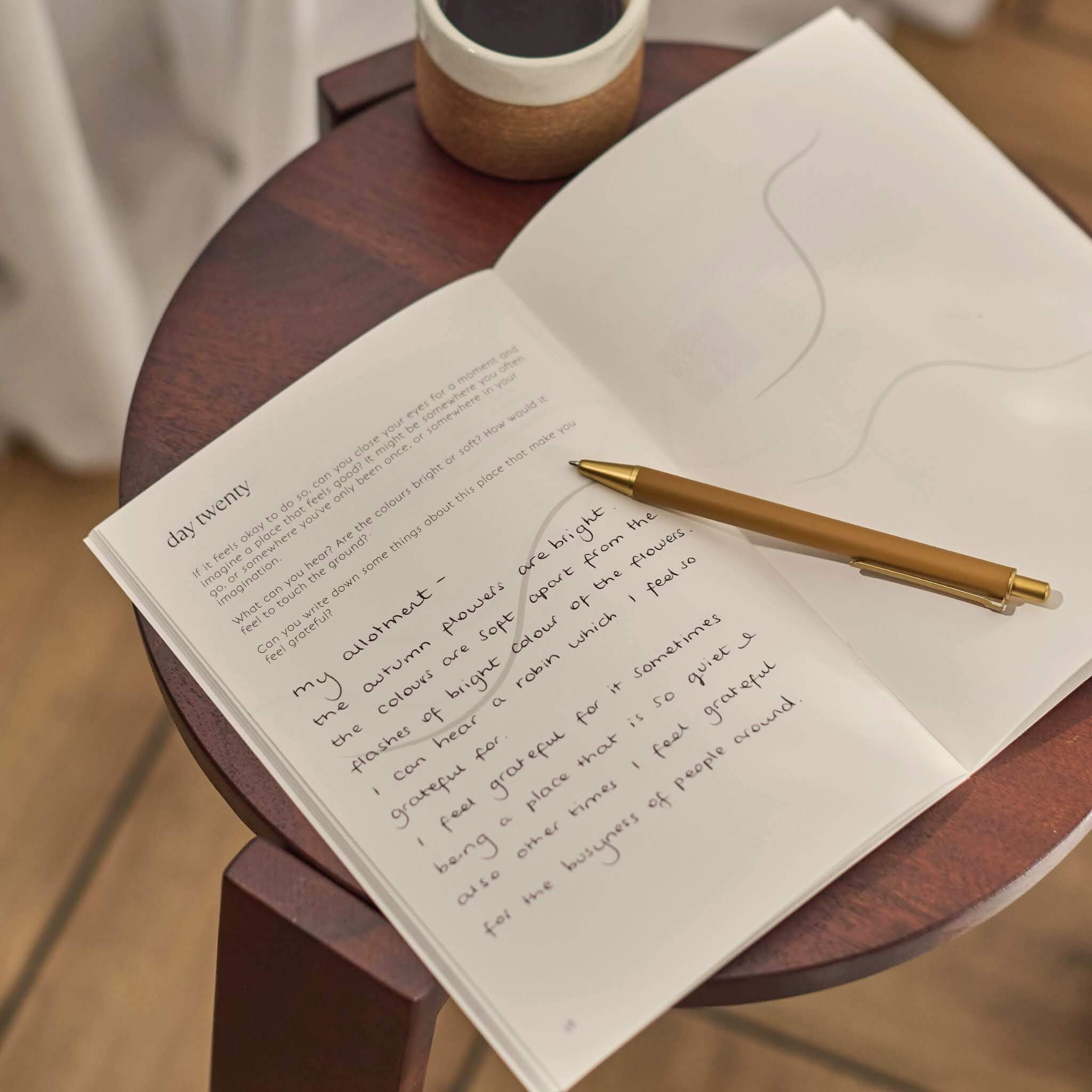
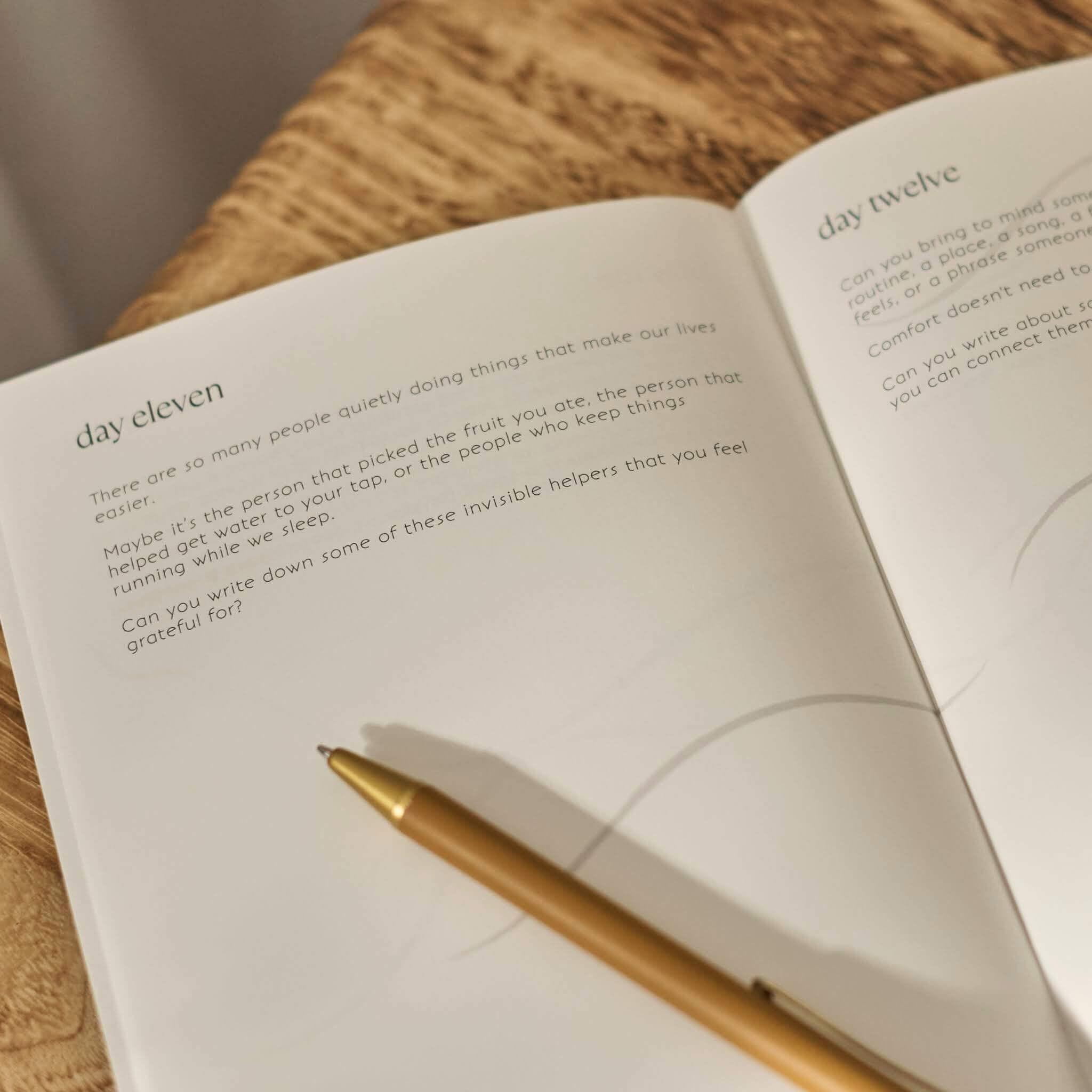
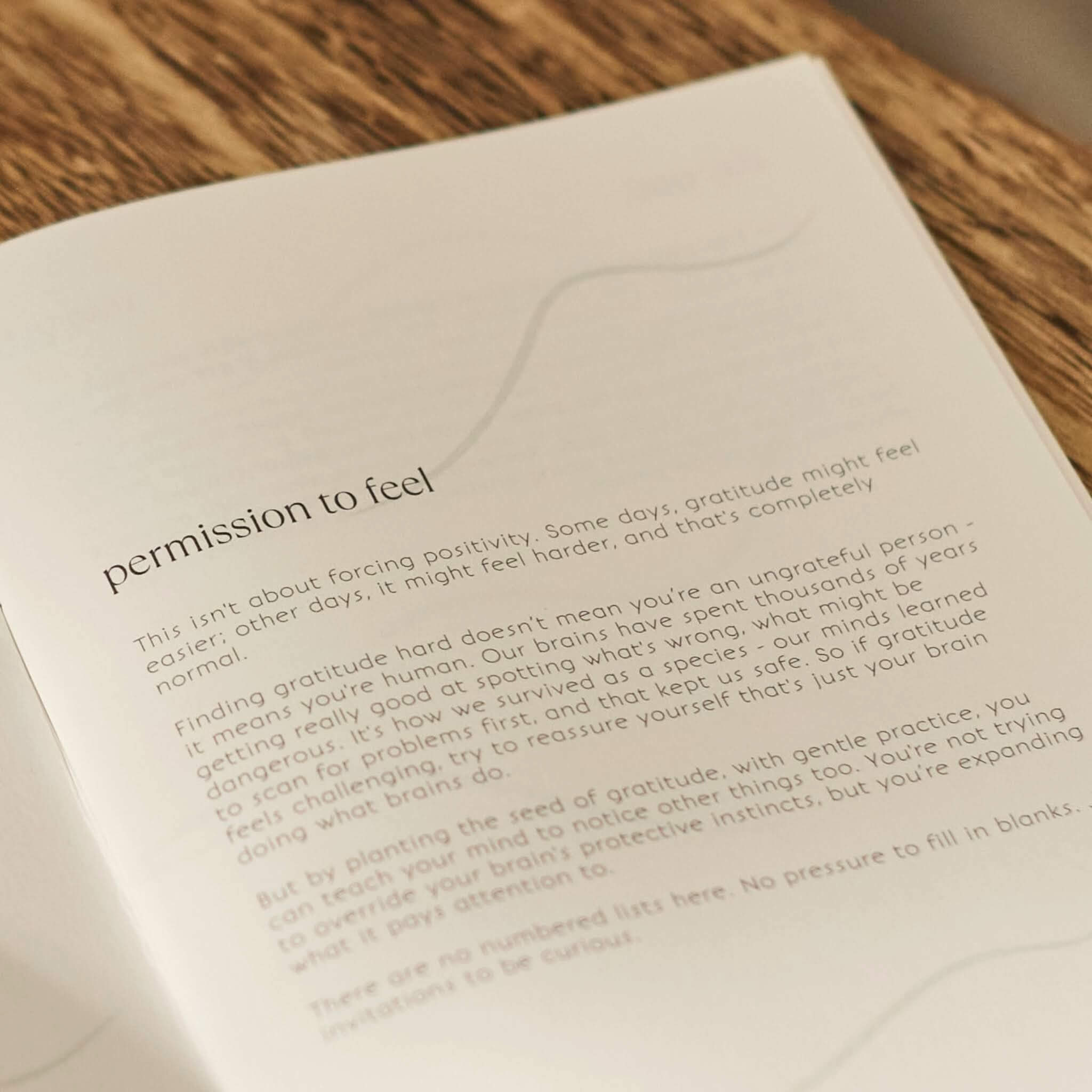
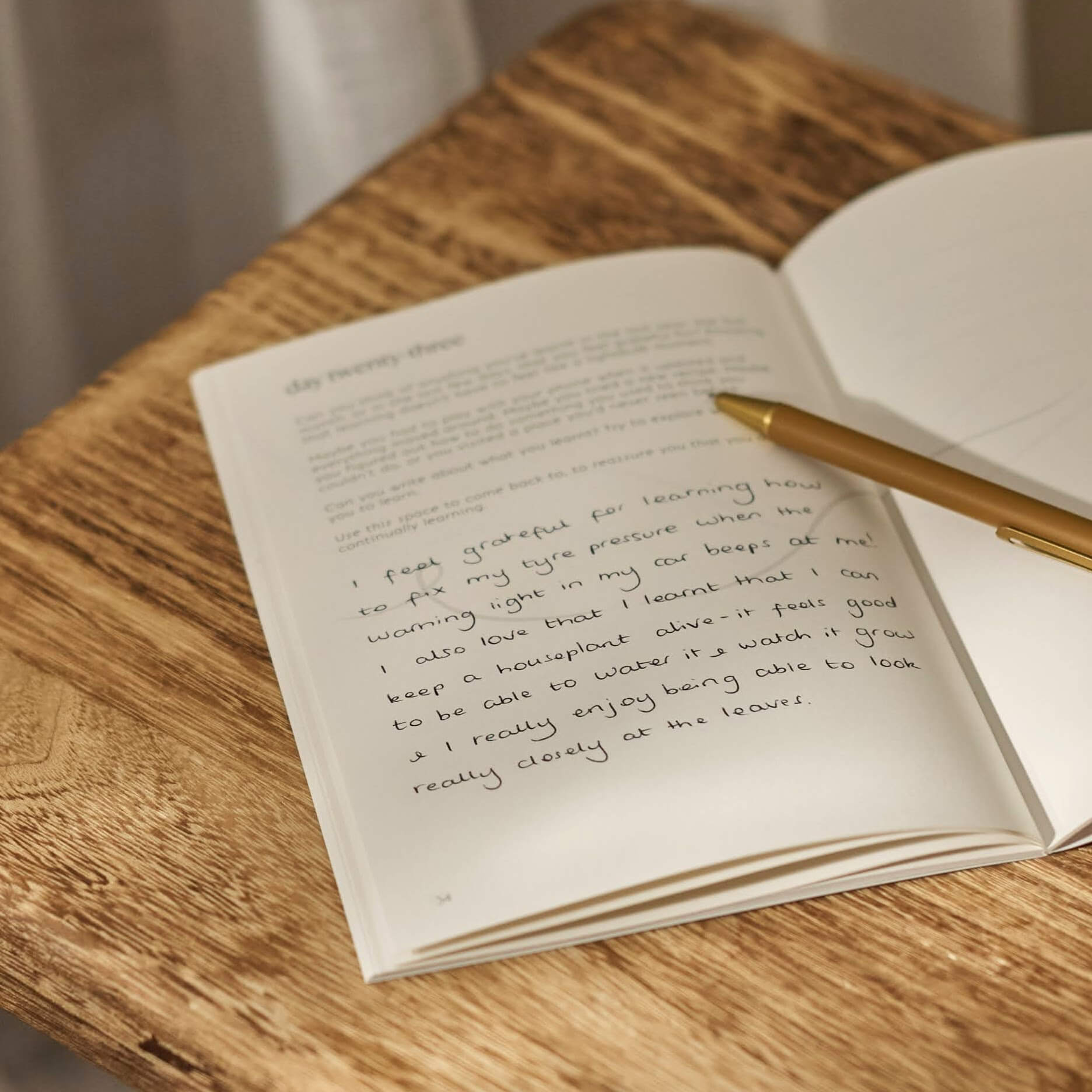
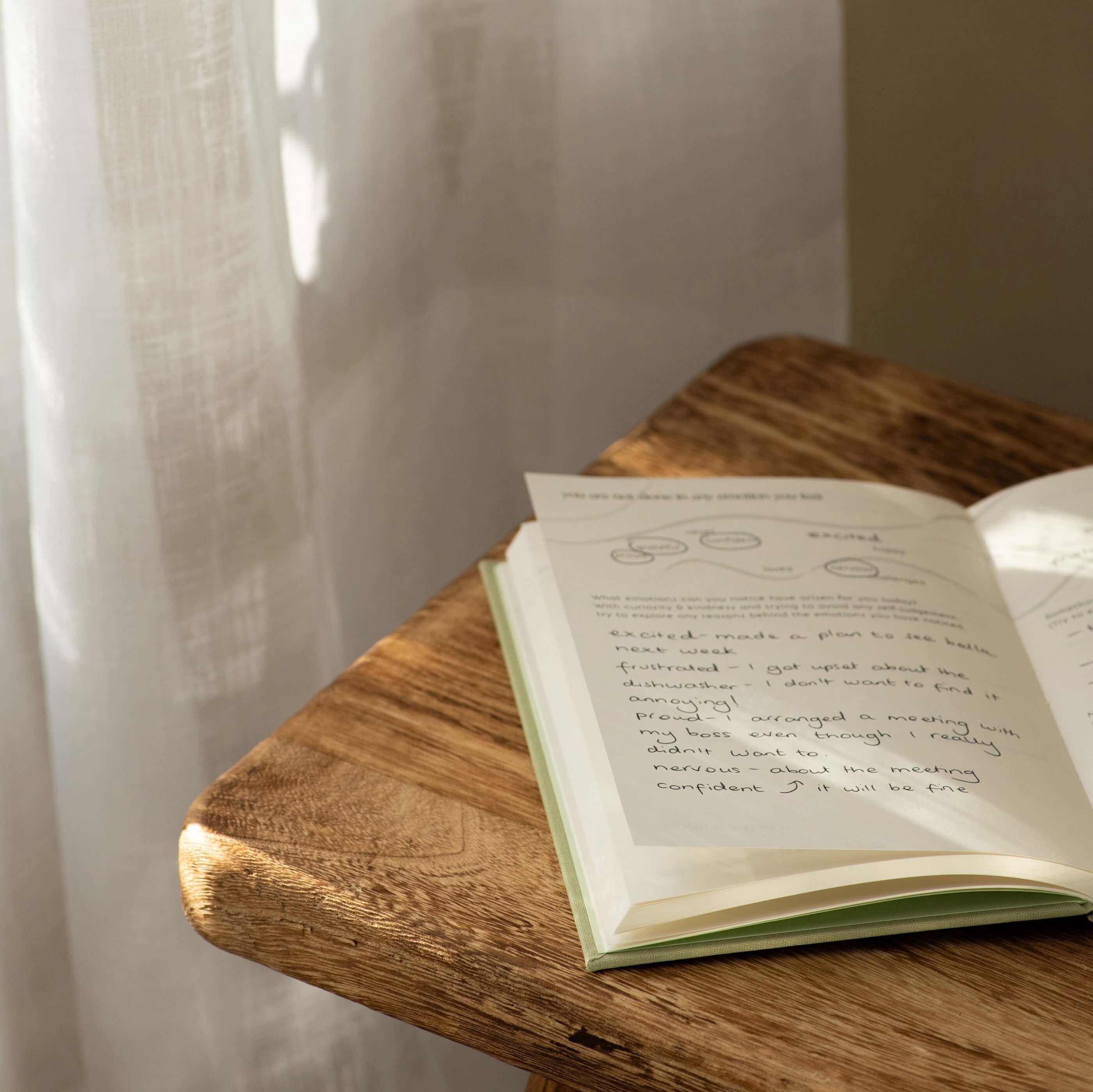
- 90 days of changing prompts that model a kinder voice, rather than leaving you to generate one
- An emotional awareness tool on every page, for the evenings when you know you feel awful and cannot get more specific than that
- Nothing to score and nothing to keep on top of — no tracking, no rating, no streak to break
- Undated, so a gap of three weeks is not a row of blank days telling you that you have failed at this too
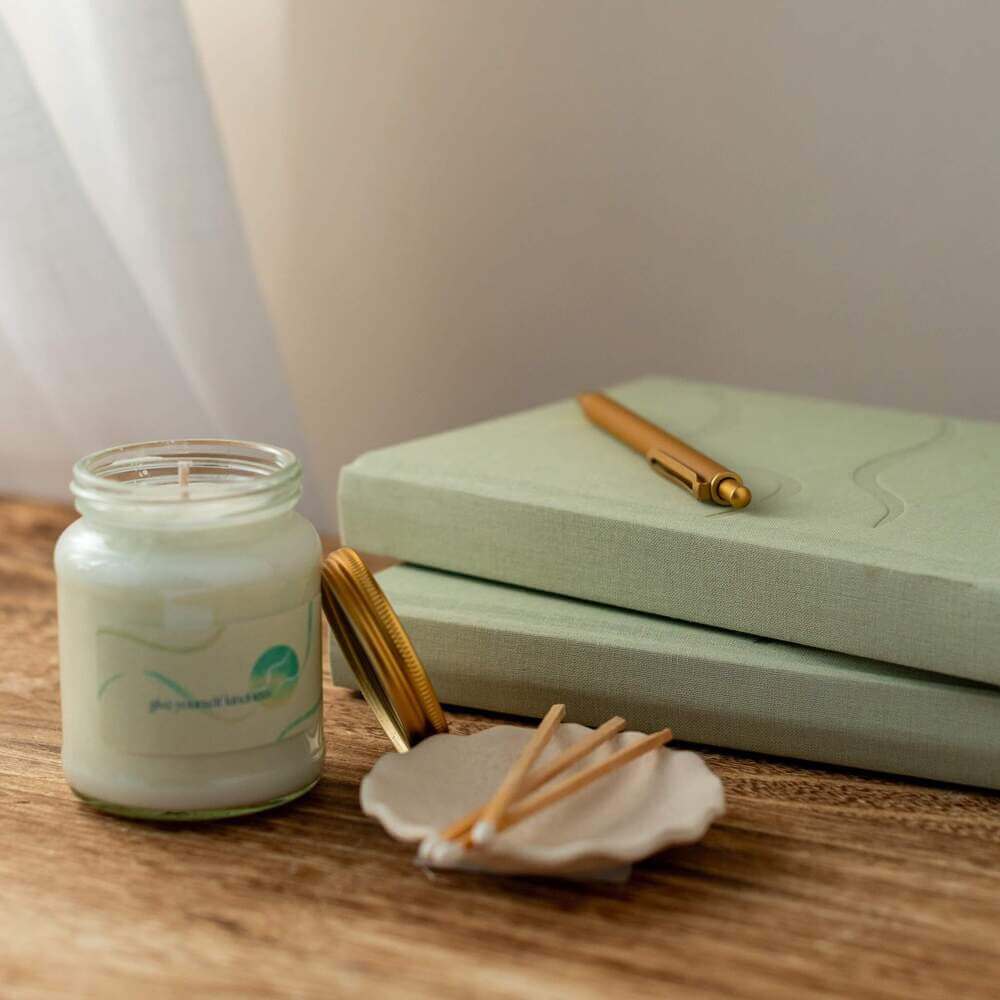
224 pages, A5, pistachio green cloth cover, 120gsm FSC-certified paper, ribbon marker, over 50 gentle affirmations, printed in the UK.
What makes it different, for this particular difficulty, is what it does not ask of you. It removes the blank-page problem on the evenings when deciding is beyond you, it validates a difficult feeling rather than pushing you to be positive about it, and it has been reviewed by clinical psychologists and is used by therapists with their clients.
What independent experts have said about it

Dr Chris Germer, PhD
Clinical Psychologist, Harvard Medical School | Co-developer of the Mindful Self-Compassion programme, taught to over 250,000 people worldwide
See Dr Germer’s review alongside the rest →“A warm invitation to make friends with your emotions and yourself!”

Carrie Pollard, MSW RSW
Experienced Psychotherapist
Read all professional reviews from therapists and clinical psychologists →“By far my favourite guided journal that I’ve used!”
It is a gentle companion alongside professional support, never a replacement for it. And if what you actually need is fewer hours or more help, a journal is not the thing that answers that.
If you would rather compare before you decide
Mine is not the only one, and for this particular difficulty the thing that matters most is what a journal asks of you. Anything that wants you to log, rate and score will hand your critic a new scoreboard, which is the opposite of what someone who cannot rest needs.
I have set out what to look for, alongside the other options, on my comparison of the best self-care journals. Go there if you would rather weigh it up properly. There is also a wider comparison of self-compassion journals if that is the angle you want.
When to get more support
If you are exhausted in a way that sleep does not touch, if nothing has felt worth doing for weeks, or if the sense of not deserving care has tipped into feeling that things would be better without you — please talk to your GP or another health professional. That is not an overreaction and it is not a failure to cope.
Persistent exhaustion also has physical causes worth ruling out, and that is a more useful line of enquiry than any conclusion about your character.
In the UK you can call the Samaritans free on 116 123, at any hour. If you are elsewhere, your local crisis line will be listed by Find a Helpline. Asking for help is one of the most self-compassionate things available to a person — it is the second part of Dr Irons’ definition: noticing suffering, then taking wise action about it.
Before you close this page
If you take one thing from all of this, I would like it to be that you are allowed to stop before you have proved anything. Rest is not a prize at the end of a good enough day. It is part of how a person keeps working at all.
The belief that you do not deserve it may still be there tomorrow. That is fine. You do not have to win the argument, and it was never going to be won by thinking harder about it. You can leave the question open and take the minute anyway, and the minute still counts.
Tonight, if you would like somewhere to start:
- Take the one minute — sit, breathe, notice your body, notice the room, notice one thing you are grateful for
- Say the one line you disbelieve least, rather than the one that sounds nicest
- Do the smallest version of what you would do for someone you love who was this tired
Be gentle with yourself tonight. Not because you have earned it, and not because you have not. There is no right or wrong way to do this. There is just the next kind thing, and then the one after that.
Dr Michelle Chung
Clinical Psychologist | Head of her own private practice | Writing for Give Yourself Kindness
“The greatest transformations don’t happen in leaps and bounds. They happen in these micro-moments of presence, gratitude, and connection... May you find grace in the smallest of moments today. And may those moments remind you of your worth, your resilience, and your capacity for joy—exactly as you are.”
Dr Chung ends her article with that, and I have not been able to improve on it, so I have left it to her.
Read Dr Chung’s full article: the art of mindful self-care →Discover the Give Yourself Kindness Journal
Questions people ask
Why do I feel like I do not deserve self-care?
Because looking after yourself has become something that feels as though it has to be earned, and the standard for having earned it is set by the same voice that is refusing you the break. Clinical psychologist Dr Chris Irons describes the fear of being fundamentally unworthy of compassion as one of the ten most common fears of self-compassion, often connected to deep-seated feelings of shame. It is a described, studied pattern rather than something wrong with you.
Is needing rest a sign of weakness?
No. Clinical psychologist Dr Michelle Chung puts it directly: rest is not the enemy of success, it is its foundation. She describes rest, reflection and stillness as forms of productivity in their own right, the quiet spaces where creativity blooms, resilience builds and clarity emerges. Needing rest is a fact about being a person, and it does not become negotiable because you are the person in question.
What is the difference between self-care and self-compassion?
Self-care is what you do: the sleep, the food, the walk outside, the minute of sitting still. Self-compassion is how you treat yourself while you do it, and whether you let yourself have it at all. They matter to each other because most people who cannot manage self-care do not have an information problem. The knowledge that you should eat something and go to bed is already there. What is missing is the permission.
Do I have to believe I deserve self-care before I can do it?
No, and this is the most useful thing to know about it. Deservingness is not part of the definition. Dr Chris Irons sets out compassion in Compassion-Focused Therapy as a sensitivity to the suffering of self and others, with a commitment to relieve and prevent it. The test is that suffering is present and something can be done about it. Whether the person has earned it does not appear.
Why do I feel guilty when I rest?
Because a rule that says rest must be earned does not switch off simply because you have decided to sit down. The guilt tends to arrive whether you rest or not, which means it is not reliable information about whether resting is the right choice. It is worth treating it as noise from an old rule rather than as a verdict, and resting anyway while it complains.
Is self-care selfish?
The fear of selfishness is one of the ten common fears of self-compassion that Dr Chris Irons describes, and it is worth separating from what is actually happening. Dr Michelle Chung tells her clients that your ability to show up for others is only as strong as your ability to show up for yourself. Running yourself down until you collapse is not generosity, and it is not something the people who rely on you would choose for you.
Is self-care just self-indulgence?
No, and the difference is not how nice something feels, it is what it is aimed at. Dr Kristin Neff draws the line clearly: self-indulgence involves choosing short-term pleasure at the expense of long-term harm, and self-compassion always has its eyes on the prize of alleviating suffering. In her own example the indulgent choice is turning off the alarm for more sleep, and the caring choice is going to bed earlier so there is enough rest to begin with.
How do I practise self-care when I have no time?
By using the version that does not need any. Dr Michelle Chung argues that self-care does not require a two-hour yoga class, a tropical retreat or even an uninterrupted evening, and that it can be found in the tiniest moments. Three deep breaths before a meeting counts. Noticing the cool water on your hands while washing dishes counts. Her 60-second challenge is to sit still, breathe, notice your body, notice your surroundings, and notice one thing you are grateful for.
Why do I look after everyone else but not myself?
Because two different rules are in play rather than one rule being applied badly. Other people’s needs read as real and legitimate, and your own read as preferences that should be possible to override. Noticing that the generous rule exists and is simply not pointed at you is often more useful than trying to feel differently, because it turns an apparent character flaw into an inconsistency you can correct.
What do I say to myself when I am too tired to keep going?
Avoid anything beginning with I am worthy or I deserve this, because a statement you do not believe invites an argument you will win. Use a description instead of a declaration. Something like: I am tired, and tired is a real state rather than an excuse. I do not have to finish the list to be allowed to stop. Sitting down is maintenance, not a reward.
What counts as self-care if I cannot afford anything?
Almost all of the self-care that helps most costs nothing. Sleep, water, food that is actually food, a walk outside, saying no to one thing, a minute of sitting still, speaking to yourself gently when you make a mistake. Dr Stan Steindl’s list of self-compassionate actions begins with letting yourself rest when you are tired, and nothing on it requires a purchase.
Do I need therapy for this?
Many people work on this themselves, with practice and time and someone to talk to. Therapy is worth considering if the sense of not deserving care goes back a long way, if it is bound up with something that happened to you, or if you only ever rest once you have collapsed. Compassion-Focused Therapy was developed specifically for difficulties rooted in shame and self-criticism.
Continue reading
From the psychologists quoted here
-
The art of mindful self-care: why small moments matterDr Michelle Chung, Clinical Psychologist — the 60-second challenge, and why rest is the foundation of success
-
The 10 common fears of self-compassionDr Chris Irons, DClinPsy, Clinical Psychologist and CFT researcher — unworthiness, weakness and the eight others
-
Why is self-compassion so hard?Dr Bianca Nardini, Clinical Psychologist — standards, and the two coaches
-
Working through ambivalence about self-compassionDr Stan Steindl, University of Queensland — starting before the resistance is resolved
-
Self-compassion or self-indulgence?Dr Kristin Neff, University of Texas at Austin — where the line actually falls
-
Do affirmations really work? I asked 5 psychologistsDr Jeffrey McDonnell, Specialist Clinical Psychologist, and four others
Related guides
- How to practise self-soothing — Dr Natalie Chua and Clare Karasik, MSW RSW, for when you want something to do rather than think about
- How to be kinder to yourself — the full practice guide, including what to do when the kindness will not go in
- How to improve your self-worth — if the sense of not being worth much goes wider than rest
- Why am I so hard on myself? — where the critical voice tends to come from
- Affirmations for burnout — written for the point where the doing has stopped working
- The best self-care journals compared — what to look for, including options that are not mine
- Best self-compassion journals compared — honest comparison, real alternatives
- What mental health experts say about the journal